
 by
by What is the Radioembolization Therapy Market Size in 2026?
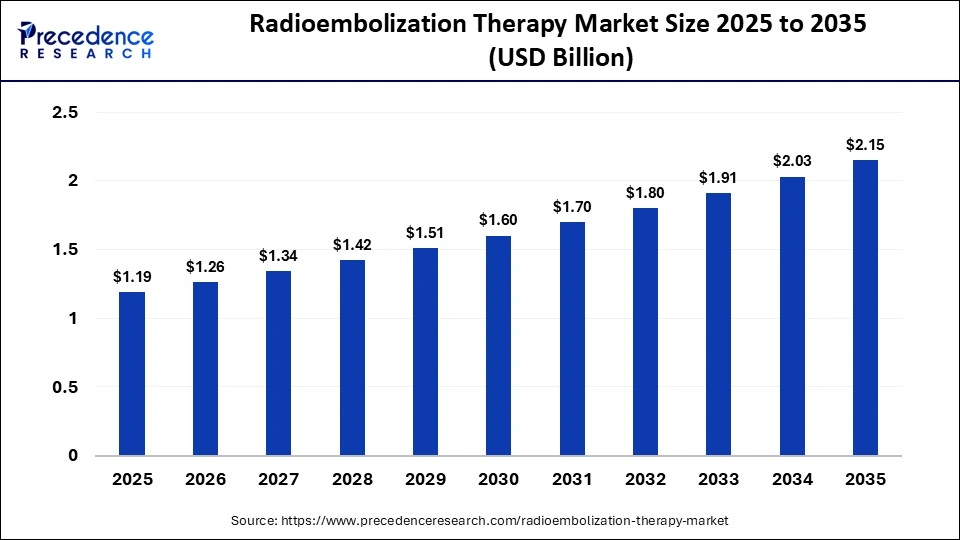
The global radioembolization therapy market was valued at USD 1.19 billion in 2025 and is projected to increase to USD 1.26 billion in 2026. Over the forecast period, the market is expected to reach approximately USD 2.15 billion by 2035, expanding at a CAGR of 7.64% from 2026 to 2035.
Market growth is primarily driven by
-
Rising global prevalence of liver cancer
-
Growing demand for minimally invasive cancer treatments
-
Technological advancements in interventional oncology
-
Increasing adoption of targeted radiation therapies
-
Expanding healthcare infrastructure in emerging economies
Read Also: AI in Medical Billing Market
What is the Radioembolization Therapy Market?
Radioembolization therapy is a targeted internal radiation treatment primarily used to treat primary and metastatic liver cancer. The therapy involves delivering radioactive microspheres—commonly Yttrium-90 (Y-90)—directly into liver tumors through the hepatic artery.
This therapy:
-
Combines embolization with radiotherapy
-
Delivers high-dose radiation directly to tumors
-
Minimizes damage to surrounding healthy tissues
-
Serves as a treatment option for unresectable liver cancers
Radioembolization therapy is considered a specialized segment within interventional oncology, offering effective palliative and disease-control solutions.
Key Takeaways
-
North America dominated the global market in 2025.
-
Asia Pacific is expected to grow at the fastest CAGR during the forecast period.
-
Yttrium-90 microspheres led the product segment in 2025.
-
Holmium-166 microspheres are projected to grow at the highest CAGR.
-
Selective Internal Radiation Therapy (SIRT) held the majority revenue share in 2025.
-
Segmental radioembolization is expected to grow rapidly.
-
Trans arterial radioembolization dominated the technology segment.
-
Primary liver cancer was the leading application in 2025.
-
Metastatic liver cancer is forecasted to grow the fastest.
Role of Technology in Market Growth
Technological advancements are central to improving precision, safety, and patient outcomes in radioembolization therapy.
Advanced Microsphere Technology
Sophisticated glass and resin microspheres enable accurate delivery of high-dose radiation directly to tumors.
Major systems include products developed by companies such as:
-
Sirtex Medical
-
Boston Scientific Corporation
Imaging Integration
Advanced imaging technologies such as:
-
SPECT
-
PET
-
MRI
-
3D imaging
help optimize tumor localization, dose planning, and treatment verification.
AI & Machine Learning
Artificial intelligence enhances:
-
Dose calculation accuracy
-
Treatment planning
-
Patient outcome prediction
-
Personalized therapy mapping
These advancements reduce hospital visits and enable faster, sometimes single-day, procedures.
Radioembolization Therapy Market Trends
Growing Demand for SIRT
Selective Internal Radiation Therapy (SIRT) is gaining popularity due to its high effectiveness in treating unresectable hepatocellular carcinoma.
Personalization & Voxel-Based Dosimetry
Advanced voxel-based radiation mapping allows improved tumor targeting while reducing cold spots and minimizing side effects.
Shift Toward Minimally Invasive Procedures
Patients and clinicians increasingly prefer minimally invasive treatments over conventional surgery or systemic chemotherapy due to:
-
Lower complication risks
-
Faster recovery
-
Improved quality of life
Segmental Insights
By Product Type
Yttrium-90 Microspheres Dominated in 2025
The Yttrium-90 (Y-90) microspheres segment led the market due to:
-
Widespread clinical usage
-
FDA approvals
-
High physician familiarity
-
Strong global distribution networks
These microspheres are available in glass and resin variants and offer effective tumor control, even in patients with portal vein thrombosis.
Key manufacturers include:
-
Sirtex Medical
-
Nordion Inc.
Holmium-166 Microspheres to Grow at Fastest CAGR
Holmium-166 microspheres are gaining momentum due to their theranostic capabilities. They allow:
-
Precise pre-treatment imaging
-
Real-time dosimetry verification
-
MRI compatibility
-
Improved safety and tumor-specific dosing
By Procedure Type
Selective Internal Radiation Therapy (SIRT) Led in 2025
SIRT, also known as Transcatheter Arterial Radioembolization (TARE), accounted for the largest revenue share.
It is widely used for:
-
Hepatocellular carcinoma (HCC)
-
Liver metastases
-
Unresectable tumors
SIRT is increasingly integrated with immunotherapy, opening new therapeutic pathways.
Segmental Radioembolization to Grow Rapidly
Segmental radioembolization focuses on delivering ablative doses to localized tumors, offering:
-
Curative-intent treatment
-
Reduced radiation-induced liver disease
-
Better tumor control
-
Hypertrophy of healthy liver tissue
By Technology
Trans Arterial Radioembolization Dominated in 2025
This segment held the largest share due to:
-
Targeted Y-90 delivery
-
Fewer side effects compared to chemoembolization
-
Ability to treat portal vein thrombosis
-
Effective tumor downstaging
SIRT Technology to Witness Fastest Growth
SIRT’s expanding applications, improved outcomes, and rising adoption in inoperable cases are driving rapid growth.
By Application
Primary Liver Cancer Led the Market in 2025
Primary liver cancer is dominant due to:
-
Rising hepatocellular carcinoma cases
-
Superior tumor targeting
-
Minimally invasive palliative care options
Metastatic Liver Cancer to Grow Fastest
Growth is driven by:
-
Increasing colorectal cancer metastases
-
Strong clinical evidence supporting Y-90 efficacy
-
Longer time-to-progression compared to chemotherapy
Competitive Landscape
Key players operating in the global radioembolization therapy market include:
-
Sirtex Medical
-
Boston Scientific Corporation
-
Terumo Corporation
-
Merit Medical Systems, Inc.
-
ABK Biomedical Inc.
-
TriSalus Life Sciences
-
Guerbet
-
Varian Medical Systems
-
Cook Medical Inc.
For inquiries regarding discounts, bulk purchases, or customization requests, please contact us at sales@precedenceresearch.com

