
 by
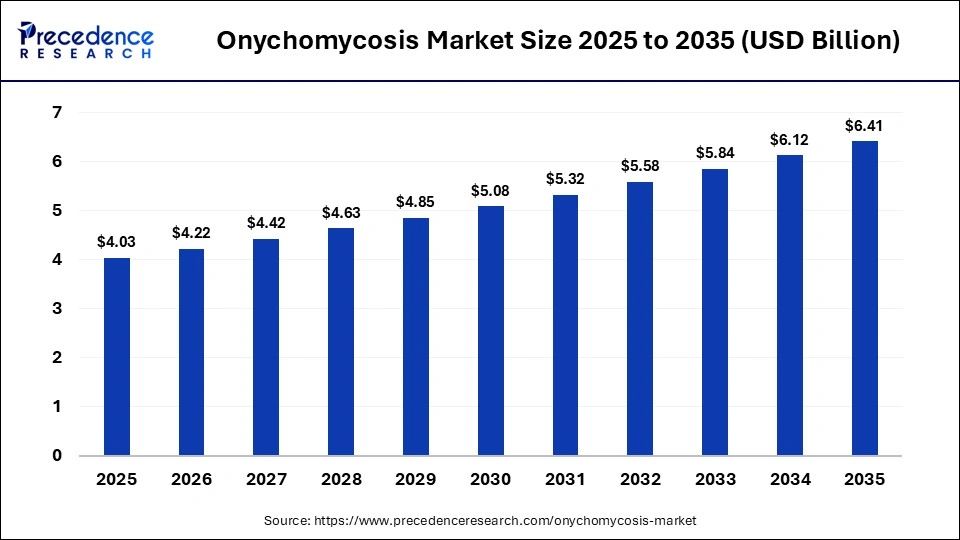
by The global onychomycosis market size was valued at USD 4.03 billion in 2025 and is projected to increase to USD 4.22 billion in 2026. The market is expected to reach approximately USD 6.41 billion by 2035, expanding at a CAGR of 4.74% from 2026 to 2035. Market growth is primarily driven by the increasing prevalence of diabetes, a growing geriatric population, rising awareness of nail health, and continuous advancements in antifungal treatments and diagnostic technologies.
Read Also: Soft Tissue Allograft Market
Key Takeaways
-
North America dominated the global market in 2025
-
Asia-Pacific is projected to grow at the fastest CAGR (2026–2035)
-
Distal subungual onychomycosis led the type segment in 2025
-
White superficial onychomycosis is expected to grow at the highest CAGR
-
Topical treatments dominated the market in 2025
-
Oral antifungal treatments are expected to grow fastest during the forecast period.
Market Overview
Onychomycosis, a fungal infection of the nails, is becoming increasingly common worldwide. The condition is particularly prevalent among diabetic patients, elderly individuals, and immunocompromised populations.
Rising healthcare awareness, improved diagnostic capabilities, and increasing cosmetic concerns related to nail appearance are fueling treatment demand. Additionally, growing research and development investments are accelerating the launch of innovative antifungal drugs and advanced drug delivery systems.
How Artificial Intelligence is Transforming the Onychomycosis Market
Artificial Intelligence (AI) is playing a critical role in improving diagnosis and treatment strategies for onychomycosis.
AI-powered convolutional neural networks are being used to analyze dermoscopic and microscopy images with diagnostic accuracy exceeding 90%, often outperforming experienced dermatologists. AI-based mobile applications are also enabling remote diagnosis, especially in underserved and rural areas.
Furthermore, machine learning models assist healthcare providers in:
-
Personalizing treatment plans
-
Optimizing antifungal dosage
-
Monitoring patient response in real time
-
Predicting potential adverse reactions
These innovations are enhancing patient outcomes and reducing recurrence rates.
Key Market Trends
1. Rise of Advanced Topical Formulations
There is a growing shift toward improved topical antifungal treatments, including advanced nail lacquers and high-penetration solutions. Products such as efinaconazole and tavaborole are gaining strong traction due to enhanced nail-bed penetration and reduced systemic side effects.
2. Growth of OTC and E-commerce Distribution
Over-the-counter (OTC) availability and e-commerce expansion are significantly increasing product accessibility, especially in developed markets.
3. Increasing Combination Therapies
To address recurrence and improve efficacy, combination therapies—such as oral antifungals with topical agents or laser therapy—are becoming more common.
4. Surge in Diabetic and Elderly Populations
The rising prevalence of diabetes and expanding geriatric population globally continue to expand the patient pool susceptible to fungal nail infections.
5. Technological Advancements in Laser Devices
Laser-based treatments such as carbon dioxide lasers, blue light therapy, and photodynamic therapy (PDT) are emerging as effective non-invasive alternatives for patients unable to tolerate oral medications.
Segmental Analysis
By Type
Distal Subungual Onychomycosis Dominated in 2025
This segment led the market due to its high prevalence. Numerous FDA-approved treatments target this type, increasing treatment adoption and commercial availability.
White Superficial Onychomycosis to Grow Fastest
White superficial onychomycosis is expected to expand at the highest CAGR due to easier diagnosis and strong response to topical treatments, particularly lacquers and water-soluble formulations.
By Treatment
Topical Segment Led the Market
Topical treatments dominated in 2025 due to their safety profile and lower systemic side effects. They offer targeted treatment without bloodstream absorption, minimizing liver-related risks.
Oral Segment to Register Highest Growth
Oral antifungal medications are expected to grow at the fastest rate because of their superior efficacy in treating moderate to severe infections, offering cure rates between 70–90%.
Value Chain Analysis
Research & Development
Focus on novel antifungal drugs, improved nail penetration, and nanotechnology-driven formulations.
Clinical Trials & Regulatory Approval
Combination therapies, laser technologies, and next-generation antifungals are undergoing regulatory evaluations.
Manufacturing & Formulation
Development of advanced drug delivery systems, including nanoparticles, medicated lacquers, and sustained-release films.
Distribution & Patient Support
Products are distributed via hospitals, retail pharmacies, and online platforms, accompanied by patient education and support programs.
For inquiries regarding discounts, bulk purchases, or customization requests, please contact us at sales@precedenceresearch.com

