
 by
by What is the Theranostics Market Size in 2026?
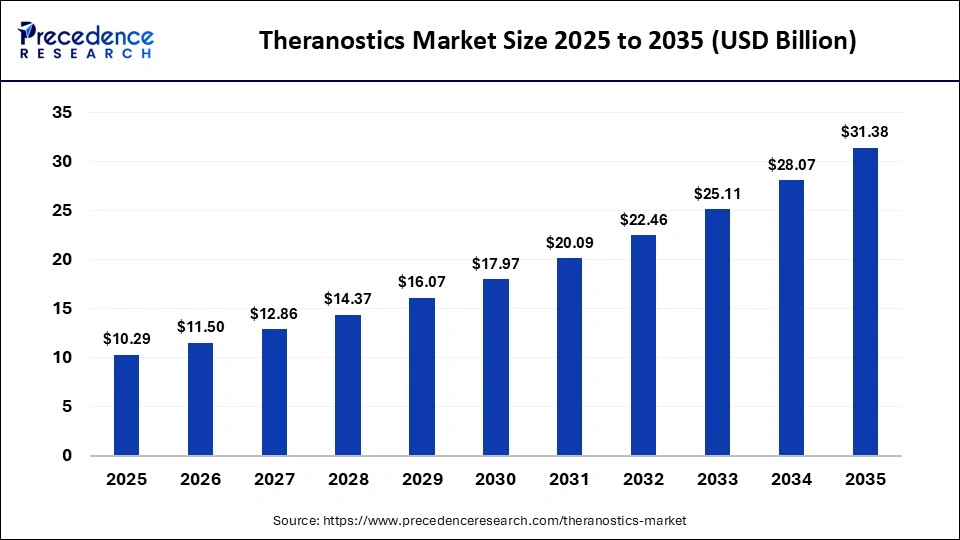
The global theranostics market size was valued at USD 10.29 billion in 2025 and is projected to grow from USD 11.50 billion in 2026 to approximately USD 31.38 billion by 2035, expanding at a CAGR of 11.8% during the forecast period.
The market is witnessing strong growth due to the increasing prevalence of chronic diseases, especially cancer, alongside the rising demand for personalized medicine and advancements in molecular imaging and radiopharmaceuticals.
Read Also: AI in Patient Management Market
Key Takeaways
- North America dominated the theranostics market in 2025
- Asia-Pacific is expected to grow at the fastest CAGR from 2026 to 2035
- Oncology was the leading application segment in 2025
- Neurology is projected to grow at the fastest rate
- Molecular imaging held the largest share by technology
- Biomarkers are expected to expand rapidly during the forecast period
- Hospitals accounted for the highest market share in 2025
- Diagnostic laboratories are expected to grow at the fastest CAGR
Market Overview
Theranostics is an advanced medical approach that integrates diagnostic imaging and targeted therapy into a single platform, primarily used in cancer treatment. It enables clinicians to identify, monitor, and treat diseases simultaneously using targeted molecular agents.
This approach improves treatment precision by delivering therapy directly to diseased cells while minimizing damage to healthy tissues. It also allows real-time monitoring of treatment effectiveness, making it a cornerstone of precision medicine.
Theranostics is particularly effective for patients with advanced or metastatic cancers, especially when traditional therapies have limited success.
Role of AI in the Theranostics Market
Artificial Intelligence (AI) is transforming theranostics by enhancing both diagnostics and targeted therapies. AI supports:
- Faster drug discovery and development
- Improved molecular imaging accuracy
- Personalized dose optimization
- Real-time monitoring of treatment response
- Development of advanced nanocarriers for drug delivery
Machine learning algorithms analyze patient-specific molecular data, improving disease detection and enabling highly personalized treatment strategies. AI also helps predict potential side effects, allowing timely clinical interventions.
Key Market Trends
Shift Toward Personalized Medicine
Theranostics is driving the transition toward personalized healthcare by tailoring treatments based on individual genetic and molecular profiles. This improves treatment efficacy and reduces toxicity.
Growth of Radiopharmaceuticals
Radiopharmaceuticals are gaining traction due to their ability to precisely target cancer cells using imaging technologies like PET and SPECT, enhancing both diagnosis and treatment.
Advancements in Molecular Diagnostics
Technologies such as next-generation sequencing (NGS), digital PCR, and liquid biopsies are enabling accurate detection of disease biomarkers, facilitating targeted therapies and real-time monitoring.
Segment Insights
Application Insights
The oncology segment dominated the market in 2025 due to the rising global cancer burden and increasing adoption of targeted therapies. Theranostics enables precise tumor detection, treatment, and monitoring, improving patient outcomes.
The neurology segment is expected to grow at the fastest rate, driven by the increasing prevalence of neurological disorders such as Alzheimer’s and Parkinson’s disease, along with advancements in brain imaging and targeted therapies.
Technology Insights
The molecular imaging segment led the market in 2025, as it enables accurate identification of biological targets and real-time monitoring of treatment responses. Techniques like PET/CT play a crucial role in precision medicine.
The biomarkers segment is projected to grow rapidly due to its importance in identifying disease-specific molecular targets and enabling personalized treatment strategies.
End-Use Insights
The hospitals segment held the largest share in 2025 due to advanced infrastructure, high patient volumes, and the ability to integrate complex imaging technologies with targeted therapies.
The diagnostic laboratories segment is expected to witness the fastest growth, driven by increasing demand for molecular testing, biomarker analysis, and advanced diagnostic techniques.
Regional Insights
North America
North America dominated the theranostics market in 2025, supported by:
- Advanced healthcare infrastructure
- High prevalence of chronic diseases
- Strong investment in R&D
- Favorable reimbursement policies
- Presence of major market players
The United States leads the region with significant innovation in molecular diagnostics and radiopharmaceutical development.
Asia-Pacific
Asia-Pacific is expected to grow at the fastest CAGR due to:
- Increasing incidence of chronic diseases
- Rapid healthcare infrastructure development
- Rising investments in biotechnology
- Government support for precision medicine
Countries like Japan are leading advancements in genomic testing, molecular imaging, and radiopharmaceutical research.
Competitive Landscape
Key companies operating in the theranostics market include:
- Bayer AG
- Novartis (Advanced Accelerator Applications)
- GE HealthCare Technologies Inc.
- Telix Pharmaceuticals Ltd.
- Curium Pharma
- Siemens Healthineers AG
- Lantheus Holdings, Inc.
- Cardinal Health, Inc.
- Jubilant Pharmova Ltd.
- ITM Isotope Technologies Munich SE
Recent Developments
- February 2026: The University of Kansas Health System and partners announced the development of a fully integrated theranostics platform to support molecular imaging and radiopharmaceutical therapies.
- November 2025: UCLA launched a new Department of Nuclear Medicine and Theranostics to advance precision medicine and research capabilities.
Future Outlook
The theranostics market is set for strong growth as precision medicine becomes a central focus in healthcare. Advancements in AI, molecular diagnostics, and radiopharmaceuticals will continue to enhance treatment accuracy and patient outcomes.
With increasing adoption in oncology and emerging applications in neurology and cardiology, theranostics is expected to play a transformative role in the future of personalized healthcare.
Get Sample: https://www.precedenceresearch.com/sample/8094
For inquiries regarding discounts, bulk purchases, or customization requests, please contact us at sales@precedenceresearch.com

- Arbovirus Testing Market Size to Hit USD 2.16 Billion by 2035 - March 23, 2026
- Theranostics Market Size to Hit USD 31.38 Billion by 2035 - March 23, 2026
- AI in Patient Management Market Size to Hit USD 51.15 Billion by 2035 - March 23, 2026
