
 by
by Particle Therapy Market Size in 2026
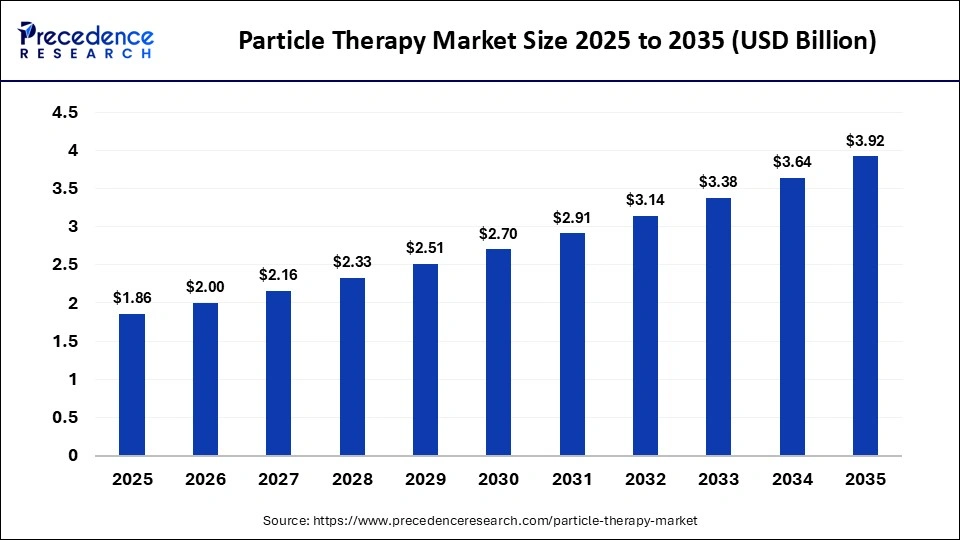
The global particle therapy market size was valued at USD 1.86 billion in 2025 and is expected to grow from USD 2.00 billion in 2026 to approximately USD 3.92 billion by 2035, expanding at a CAGR of 7.75% from 2026 to 2035. The market is witnessing steady growth due to increasing demand for advanced cancer treatment technologies and the rising adoption of precision radiotherapy.
Particle therapy, an advanced form of external-beam radiotherapy, offers superior tumor targeting compared to traditional photon therapy. It plays a crucial role in treating complex and radioresistant cancers, including renal-cell carcinoma, while minimizing damage to surrounding healthy tissues.
Read Also: Blood Group Typing Market
Market Overview
Particle therapy represents a breakthrough in oncology, enabling highly precise radiation delivery using protons or heavy ions. Unlike conventional radiation therapy, particle therapy allows clinicians to deliver higher radiation doses directly to tumors with minimal exposure to adjacent organs.
The growing burden of cancer worldwide, combined with technological advancements in radiation oncology, is significantly driving the market. Increased investments in cancer research, expansion of specialized treatment centers, and the rising adoption of advanced healthcare infrastructure are further supporting market growth.
Impact of Artificial Intelligence on Particle Therapy
Artificial Intelligence (AI) is transforming the particle therapy landscape by enhancing treatment accuracy, efficiency, and workflow automation.
AI applications in particle therapy include:
- Treatment planning optimization through automated dose calculations and beam angle selection
- Real-time imaging and simulation for improved tumor targeting
- Quality assurance via deep-learning algorithms for dose verification
- Patient positioning and monitoring during therapy sessions
- Workflow automation, reducing manual intervention and improving consistency
These innovations enable faster, more reliable treatment planning and delivery, significantly improving patient outcomes.
Key Market Trends
Rising Clinical Research Activities
Clinical trials focusing on proton therapy, carbon ion therapy, and other heavy particle treatments are increasing globally. Research into advanced therapies such as helium ion therapy and FLASH radiotherapy is gaining traction.
Precision Oncology Advancements
Particle therapy is increasingly used for tumors located near critical organs like the brainstem, spinal cord, and heart, where precision is essential.
Growing Demand for Safer Treatments
The therapy is gaining popularity due to its ability to reduce side effects and improve quality of life, especially for pediatric and recurrent cancer patients.
Market Scope
- Market Size in 2025: USD 1.86 Billion
- Market Size in 2026: USD 2.00 Billion
- Market Size by 2035: USD 3.92 Billion
- CAGR (2026–2035): 7.75%
- Base Year: 2025
- Forecast Period: 2026–2035
- Dominant Region: North America
- Fastest Growing Region: Asia Pacific
Segmental Insights
By Type
Proton Therapy Dominance
The proton therapy segment held the largest market share in 2025, accounting for 88% of the market. Its dominance is attributed to:
- High precision dose delivery
- Reduced radiation exposure to healthy tissues
- Advancements like pencil beam scanning and FLASH therapy
Heavy Ion Therapy Growth
The heavy ion therapy segment is expected to grow at the fastest CAGR due to its superior biological effectiveness and increasing research into carbon, helium, and oxygen ion therapies.
By System
Multi-Room Systems Lead
Multi-room systems dominated the market due to their ability to treat a large number of patients in major cancer centers and research institutions.
Single-Room Systems Expansion
Single-room systems are projected to grow rapidly due to:
- Compact design
- Lower infrastructure costs
- Increased accessibility for smaller hospitals
By Application
Clinical Research Dominance
Clinical research led the market in 2025, driven by ongoing studies on advanced cancer therapies and combination treatments.
Treatment Segment Growth
The treatment segment is expected to grow at the fastest rate due to increased adoption of particle therapy for:
- Radioresistant tumors
- Pediatric cancers
- Recurrent cancers
By Cancer Type
Pediatric Cancer Leadership
Pediatric cancer dominated the market due to the need for safer treatment options that minimize long-term side effects in children.
Breast Cancer Growth
The breast cancer segment is expected to grow rapidly, especially for:
- Left-sided breast cancer
- Recurrent cases
- Patients with pre-existing heart or lung conditions
Regional Insights
North America
North America held the largest market share of 38% in 2025 due to:
- Advanced healthcare infrastructure
- High adoption of cutting-edge technologies
- Strong government support and funding
The U.S. leads the region with increasing adoption of compact proton therapy systems and AI-driven treatment planning solutions.
Asia Pacific
Asia Pacific is expected to grow at the fastest CAGR due to:
- Rising cancer incidence
- Expanding healthcare infrastructure
- Growing medical tourism
- Government initiatives supporting oncology advancements
Countries such as China, Japan, and India are investing heavily in particle therapy centers and research facilities.
Europe
Europe is witnessing notable growth due to:
- Favorable reimbursement policies
- Strong research ecosystem
- Increasing adoption of advanced radiotherapy technologies
Competitive Landscape
Key companies operating in the particle therapy market include:
- Ion Beam Applications S.A.
- Varian Medical Systems
- Hitachi, Ltd.
- Mevion Medical Systems, Inc.
- Sumitomo Heavy Industries, Ltd.
- Mitsubishi Electric Corporation
- Toshiba Energy Systems and Solutions
- ProTom International, Inc.
- Advanced Oncotherapy plc
- P-Cure Ltd.
These companies are focusing on technological innovation, partnerships, and expansion of treatment facilities to strengthen their market presence.
Recent Developments
- In July 2025, Hitachi Ltd. received an order to establish a new proton therapy facility in Tokyo, featuring advanced accelerator systems and rotating gantry rooms.
- In May 2024, Varian Medical Systems introduced advanced oncology solutions, including Hypersight imaging and ARIA CORE management systems, enhancing personalized cancer care.
- In February 2026, BIOEMTECH partnered with Northstar Medical Radioisotopes to secure Actinium supply for advanced imaging and research applications.
Conclusion
The particle therapy market is poised for strong growth over the next decade, driven by increasing cancer prevalence, technological advancements, and the demand for precision oncology. With continuous innovations in proton and heavy ion therapy, along with AI integration, particle therapy is set to become a cornerstone in modern cancer treatment.
As healthcare systems worldwide focus on improving patient outcomes and minimizing treatment-related side effects, the adoption of particle therapy is expected to rise significantly, creating substantial opportunities for market players.
Get Sample Copy: https://www.precedenceresearch.com/sample/8142
For inquiries regarding discounts, bulk purchases, or customization requests, please contact us at sales@precedenceresearch.com

- Endoscope Reprocessing Chemicals Market Size to Hit USD 2.06 Billion by 2035 - March 27, 2026
- Particle Therapy Market Size to Hit USD 3.92 Billion by 2035 - March 27, 2026
- Blood Group Typing Market Size to Hit USD 5.52 Billion by 2035 - March 27, 2026
