
 by
by The global optogenetics market is experiencing rapid growth, driven by increasing advancements in neuroscience research and the rising demand for innovative therapies for neurological disorders. Optogenetics, which combines genetic engineering with optical technologies, allows researchers to precisely control and monitor the activity of neurons and other cells using light. This cutting-edge approach is transforming the way scientists study brain functions and develop targeted treatments for complex conditions such as Parkinson’s disease, epilepsy, and retinal disorders.
Market Size and Forecast
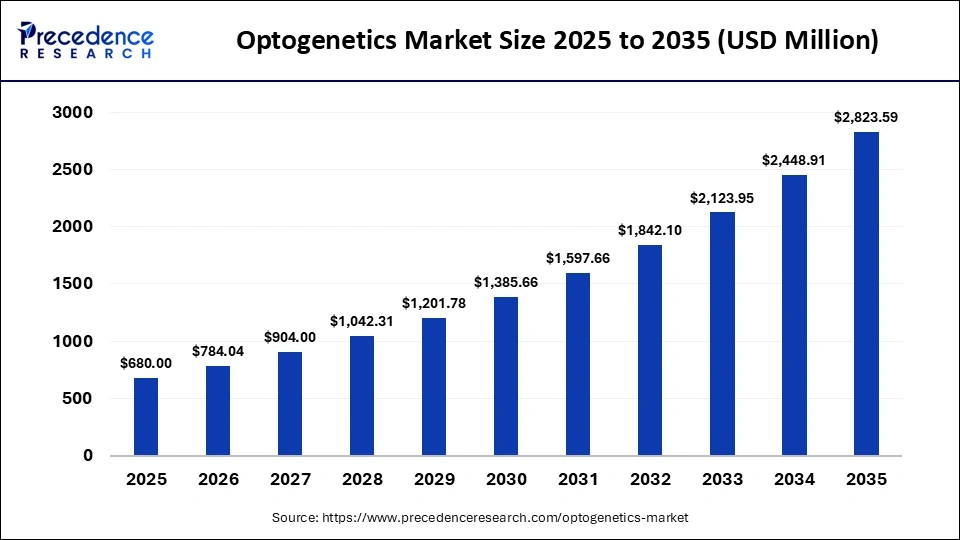
The global optogenetics market size was valued at USD 680.00 million in 2025 and is projected to grow from USD 784.04 million in 2026 to approximately USD 2,823.59 million by 2035, registering a strong CAGR of 15.30% during the forecast period from 2026 to 2035. This growth is largely fueled by increased funding in neuroscience research, the emergence of biotechnology startups, and the rising demand for non-invasive and highly targeted therapeutic solutions.
Read Also: Bone Resorption Inhibitors Market
Market Overview
Optogenetics is an advanced scientific technique that integrates genetic modification and light-based control to manipulate specific cells within living tissue. By introducing light-sensitive proteins into neurons, researchers can activate or inhibit neural activity with high precision. This capability has made optogenetics an essential tool in studying complex biological processes such as memory, learning, behavior, metabolism, and sensory functions.
The market is expanding significantly due to the increasing need for sophisticated tools that enable detailed understanding and treatment of central nervous system (CNS) disorders. Academic institutions, research organizations, and pharmaceutical companies are heavily investing in optogenetics technologies to accelerate drug discovery and develop next-generation therapies.
Impact of Artificial Intelligence on the Market
Artificial intelligence is playing a transformative role in the optogenetics market by enhancing data analysis and experimental accuracy. AI algorithms are used to analyze neural signals obtained from experiments and optimize light stimulation parameters in real time. This not only improves reproducibility but also reduces manual intervention in complex experiments.
Machine learning further enables predictive modeling of neurological conditions, helping researchers identify disrupted neural pathways and potential therapeutic targets. By integrating AI with optogenetics, researchers can accelerate discoveries and improve the development of precision medicine approaches.
Market Trends
The optogenetics market is witnessing several important trends that are shaping its future growth. There is a growing adoption of optogenetics for treating neurological disorders, particularly in areas such as Parkinson’s disease and epilepsy, where precise neural control is essential. Additionally, advancements in miniaturized and wireless light-delivery systems are improving flexibility and enabling real-time targeting of neurons in live subjects.
Another key trend is the increasing investment by biotechnology and pharmaceutical companies in gene editing and optical tools. These investments are strengthening product pipelines and encouraging collaborations aimed at developing innovative therapies for neurological and psychiatric conditions. The shift toward minimally invasive and highly targeted treatment approaches is also contributing to market expansion.
Market Dynamics
The market is primarily driven by the growing interest in gene therapy, which is revolutionizing the treatment of genetic and neurological disorders. Optogenetics enhances gene therapy by enabling precise control of genetically modified cells, thereby improving treatment effectiveness. Increasing research funding and collaborations between academic institutions and industry players are further supporting market growth.
However, the market faces certain challenges, including the relatively lower efficiency of LEDs compared to laser-based systems. Since optogenetics requires high-intensity light for accurate stimulation of neurons, limitations in light output can affect experimental precision.
Despite these challenges, the market presents significant opportunities, particularly through government initiatives supporting neuroscience research. Increasing healthcare investments and rising prevalence of neurological disorders are encouraging governments to fund advanced research programs, which in turn is accelerating the development of optogenetics technologies.
Segment Insights
In terms of product type, the light equipment segment dominated the market with a 48% share in 2025, as it plays a critical role in delivering precise light stimulation during optogenetic experiments. The segment is supported by advancements in laser and LED technologies and growing demand for accurate light delivery systems. The actuators segment accounted for 30% of the market, driven by its essential role in controlling light-sensitive cells, while the sensors segment, holding 22% share, is expected to grow at the fastest rate due to increasing demand for real-time monitoring of neural activity.
By application, the neuroscience segment held the largest share of 52% in 2025, owing to its widespread use in brain research, neural circuit mapping, and behavioral studies. The ophthalmology segment is expected to witness the fastest growth due to increasing research in vision restoration and retinal disease treatments. Cardiology applications are also gaining traction, particularly in studying heart rhythm disorders and arrhythmias.
Based on technique, the in-vivo optogenetics segment dominated the market with a 62% share, as it is widely used for studying living organisms and neural networks in real time. Meanwhile, the in-vitro segment is expected to grow steadily due to its cost-effectiveness and reliability in controlled laboratory environments.
In terms of end users, academic and research institutes led the market with a 64% share in 2025, supported by strong funding and widespread adoption of optogenetics in scientific research. Pharmaceutical and biotechnology companies are expected to grow at the fastest rate, driven by increasing investments in drug discovery and therapeutic development.
Regional Insights
North America dominated the global optogenetics market with a 40% share in 2025, supported by high research funding, advanced infrastructure, and the presence of leading biotechnology companies. The United States plays a key role in driving regional growth through strong R&D activities and early adoption of innovative technologies.
Asia Pacific is expected to grow at the fastest rate during the forecast period, driven by increasing investments in biotechnology research, expanding academic institutions, and strong government support. Countries such as China are leading the region with large-scale neuroscience initiatives and growing collaborations between research institutions and industry players.
Europe holds a significant share of the market, supported by a strong network of research institutions and increasing focus on precision medicine. Countries like Germany are actively investing in neuroscience research and advanced biomedical technologies, contributing to market expansion.
Competitive Landscape
The optogenetics market is highly competitive, with key players focusing on innovation, partnerships, and product development. Major companies operating in the market include:
- Thorlabs, Inc.
- Coherent Corp.
- Bruker Corporation
- Danaher Corporation
- PerkinElmer, Inc.
- NeuroNexus Technologies
- Plexon Inc.
- Doric Lenses Inc.
- Scientifica Ltd.
Recent Developments
Recent advancements in the optogenetics market highlight rapid innovation and commercialization efforts. In January 2026, Nanoscope Therapeutics received a patent for its multi-characteristic opsin technology aimed at vision restoration. In June 2025, GenSight Biologics expanded its production capacity to support upcoming product launches. Additionally, Bruker introduced a miniature microscope for deep brain imaging, enhancing research capabilities in optogenetics.
Conclusion
The optogenetics market is poised for substantial growth over the next decade, driven by advancements in neuroscience, increasing adoption of gene therapy, and integration of artificial intelligence. With expanding applications in healthcare, research, and biotechnology, optogenetics is emerging as a transformative technology that holds the potential to revolutionize the treatment of neurological disorders and improve human health outcomes globally.
Get Sample Link: https://www.precedenceresearch.com/sample/8274
For inquiries regarding discounts, bulk purchases, or customization requests, please contact us at sales@precedenceresearch.com

- Green Hospitals Market Size to Reach USD 140.12 Billion by 2035 - April 10, 2026
- Mother and Child Healthcare Market Size to Surpass USD 120.67 Billion by 2035 - April 10, 2026
- Nasal Sprays Market to Reach USD 38.45 Billion by 2035, - April 10, 2026
