
 by
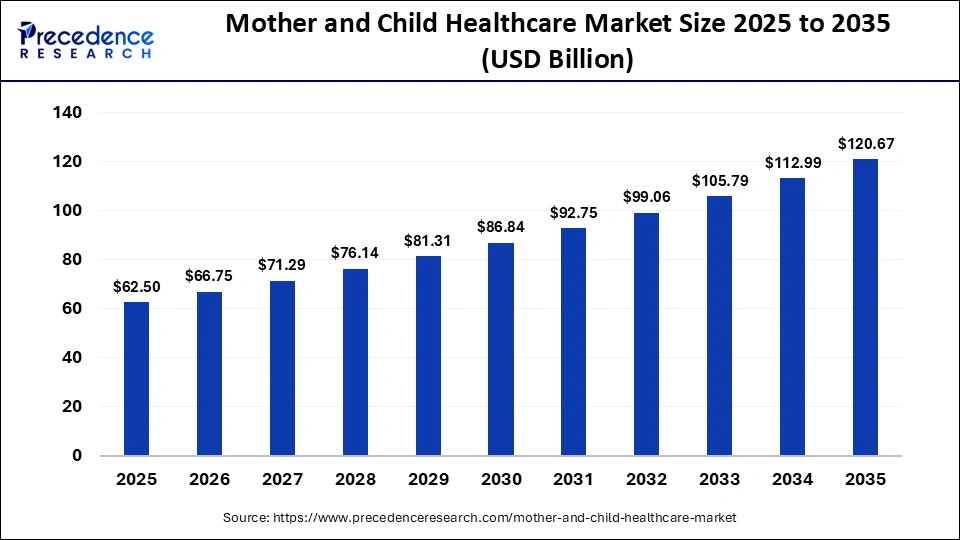
by The global mother and child healthcare market is witnessing steady expansion, with its valuation reaching USD 62.50 billion in 2025 and projected to grow to approximately USD 120.67 billion by 2035, registering a CAGR of 6.80% from 2026 to 2035. This growth is primarily driven by increasing awareness of maternal and infant health, expanding digital healthcare infrastructure, and strong government initiatives aimed at reducing mortality rates and improving healthcare accessibility.
The market is evolving rapidly with the integration of advanced technologies, rising demand for specialized pediatric and maternity services, and growing adoption of preventive healthcare practices. From prenatal diagnostics to neonatal intensive care, the ecosystem is becoming more comprehensive and patient-centric.
Read Also: Nasal Sprays Market
Quick Insights: What’s Driving the Market Forward?
The global mother and child healthcare market was valued at USD 62.50 billion in 2025 and is expected to reach USD 66.75 billion in 2026, highlighting consistent year-on-year growth.
North America emerged as the leading region, accounting for 38% of the total market share in 2025, supported by advanced healthcare infrastructure and strong policy frameworks.
The child healthcare products segment dominated the market with a 47% share, reflecting strong demand for infant nutrition, baby care products, and pediatric devices.
Hospitals remained the leading end-user segment, capturing 40% of the market share, due to their critical role in childbirth and neonatal care.
Retail distribution channels led with a 55% share, driven by accessibility and frequent purchases of essential baby and maternity products.
| Market Size (2025) | USD 62.50 Billion |
| Market Size (2026) | USD 66.75 Billion |
| Forecast (2035) | USD 120.67 Billion |
| CAGR (2026–2035) | 6.80% |
| Leading Region | North America |
How is Artificial Intelligence Transforming Mother and Child Healthcare?
Artificial Intelligence (AI) is playing a transformative role in reshaping maternal and child healthcare by enabling predictive, preventive, and personalized care. AI-powered tools are increasingly used for early risk detection in pregnancies, allowing healthcare providers to identify complications such as preeclampsia or gestational diabetes well in advance.
Moreover, AI-driven platforms are enhancing neonatal care by enabling real-time monitoring of infants in NICUs, reducing mortality rates and improving clinical outcomes. These technologies are particularly impactful in low-resource settings, where AI models can analyze patient data and provide actionable insights without requiring extensive infrastructure.
What are the Key Growth Drivers of the Market?
Growing Adoption of Digital Healthcare
The widespread adoption of telemedicine, mobile health applications, and wearable devices has significantly improved access to maternal and child healthcare services. These technologies enable remote monitoring and timely interventions, particularly for high-risk pregnancies.
Government Initiatives and Policy Support
Governments worldwide are implementing programs to reduce maternal and infant mortality, improve healthcare infrastructure, and expand insurance coverage, thereby driving market growth.
Rising Demand for Specialized Care
The increasing demand for specialized prenatal, neonatal, and pediatric services is further accelerating market expansion, supported by advancements in fertility treatments and diagnostic technologies.
What Opportunities are Emerging in the Market?
How Will AI-Based Maternal Health Prediction Shape the Future?
AI-based predictive models are creating new opportunities by enabling early diagnosis of pregnancy-related complications. These tools are particularly valuable in underserved regions, where access to specialized healthcare is limited.
Why is There a Growing Shift Toward Personalized Care?
Consumers are increasingly seeking personalized maternity and child care solutions, including customized nutrition plans, specialized birthing centers, and tailored postnatal programs.
What Role Do Nutritional Products Play in Market Expansion?
The growing focus on maternal and infant nutrition, including prenatal vitamins and fortified baby foods, is significantly contributing to market growth.
Segmental Analysis: Where is the Market Concentrated?
Why Did Child Healthcare Products Dominate the Market?
The child healthcare products segment accounted for 47% of the market share in 2025, driven by consistent demand for infant formula, baby food, and pediatric healthcare devices. These products are essential and frequently purchased, ensuring stable revenue generation.
Meanwhile, maternal healthcare products held a 45% share, supported by growing awareness of prenatal care and increasing demand for fertility treatments and monitoring devices.
Why is Neonatal Care the Leading Application Segment?
Neonatal care dominated with a 30% share in 2025, due to the critical need for specialized care for newborns, especially premature infants. Investments in NICUs and advanced medical equipment have further strengthened this segment.
Prenatal care followed closely with a 28% share, driven by the increasing importance of early diagnosis and preventive healthcare.
Why Does Retail Dominate Distribution Channels?
Retail channels led the market with a 55% share, as they provide easy access to essential maternal and child healthcare products through supermarkets, pharmacies, and e-commerce platforms.
Hospitals and clinics accounted for 35%, focusing on specialized and episodic care services.
Why Are Hospitals the Leading End Users?
Hospitals dominated the market with a 40% share, owing to their central role in childbirth, neonatal care, and complex maternal treatments.
Retailers and pharmacies followed with a 25% share, providing accessible healthcare products and services outside clinical settings.
Regional Analysis: Which Regions are Leading and Growing?
Why Does North America Lead the Market?
North America accounted for 38% of the global market share in 2025, driven by advanced healthcare infrastructure, high healthcare spending, and strong adoption of digital health technologies.
What Makes Europe the Fastest-Growing Region?
Europe is expected to witness the fastest growth due to strong regulatory frameworks, increasing adoption of advanced technologies, and rising awareness of maternal and child healthcare.
Why is Asia-Pacific Emerging Rapidly?
Asia-Pacific is experiencing significant growth due to rapid urbanization, rising disposable incomes, and increasing demand for premium healthcare services and baby care products.
Competitive Landscape: Key Companies Shaping the Market
Leading companies operating in the mother and child healthcare market include:
- Johnson & Johnson
- Abbott Laboratories
- Procter & Gamble Co.
- Philips Healthcare
- Danone S.A.
- Nestlé Health Science
- Medela AG
- Kimberly-Clark Corporation
- GE Healthcare
- Bayer AG
- Ferring Pharmaceuticals
- Mylan Pharmaceuticals
- Tetra Pak
These players are focusing on innovation, product development, and strategic collaborations to strengthen their market position.
Recent Developments and Industry Innovations
Recent advancements highlight the market’s dynamic nature. Healthcare providers are expanding specialized maternity services, while pharmaceutical companies are focusing on improving infant care solutions and safety standards.
Additionally, increasing investments in AI-based healthcare solutions and neonatal technologies are expected to redefine the future landscape of the market.
What Challenges Could Impact Market Growth?
Despite strong growth prospects, the market faces several challenges:
- Governance gaps and uneven healthcare infrastructure
- Cultural barriers limiting healthcare access in certain regions
- High costs associated with advanced maternal and neonatal care
- Limited accessibility in low-income and rural areas
These factors may hinder the adoption of healthcare services, particularly in developing economies.
Case Study: Digital Healthcare Improving Maternal Outcomes
In emerging markets, digital healthcare platforms have enabled remote monitoring of high-risk pregnancies, reducing complications and improving maternal health outcomes. Telemedicine and wearable devices are helping bridge the gap between patients and healthcare providers, particularly in rural and underserved areas.
Conclusion: A Market Driven by Innovation and Care
The mother and child healthcare market is on a steady growth trajectory, driven by technological advancements, policy support, and increasing consumer awareness. As digital health and AI continue to evolve, the market is expected to witness significant transformation, ensuring better healthcare outcomes for mothers and children worldwide.
Get Sample Link: https://www.precedenceresearch.com/sample/8280
For inquiries regarding discounts, bulk purchases, or customization requests, please contact us at sales@precedenceresearch.com

- Green Hospitals Market Size to Reach USD 140.12 Billion by 2035 - April 10, 2026
- Mother and Child Healthcare Market Size to Surpass USD 120.67 Billion by 2035 - April 10, 2026
- Nasal Sprays Market to Reach USD 38.45 Billion by 2035, - April 10, 2026
