
 by
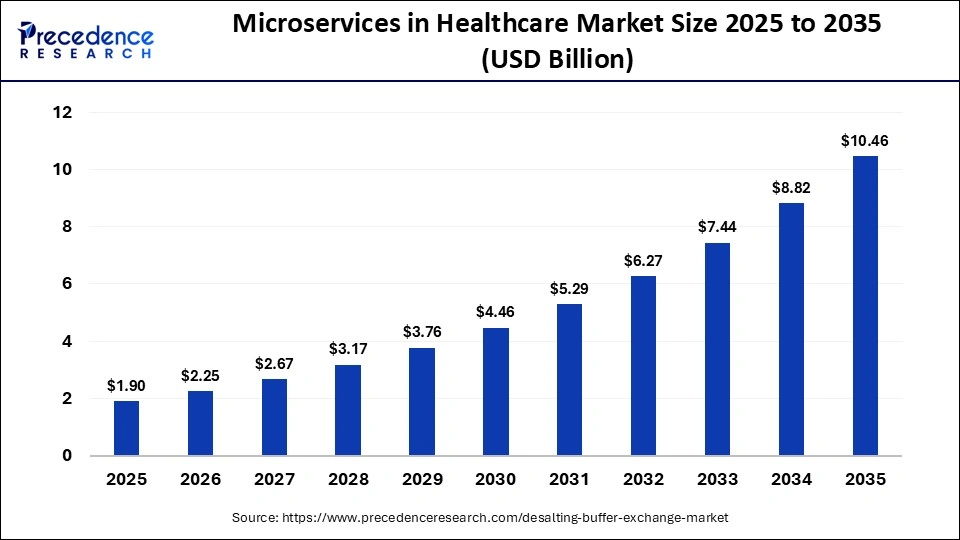
by The global microservices in healthcare market is witnessing rapid expansion, driven by the ongoing digital transformation across the healthcare ecosystem. The market size was valued at USD 1.90 billion in 2025 and is projected to grow from USD 2.25 billion in 2026 to approximately USD 10.46 billion by 2035, registering a remarkable CAGR of 18.60% during the forecast period.
Read Also: Optogenetics Market
Market Overview
Microservices architecture in healthcare refers to a modular approach to software development, where applications are broken down into smaller, independent services that can be deployed, managed, and scaled individually. This approach is transforming healthcare IT systems by enabling seamless integration across platforms such as Electronic Health Records (EHRs), telemedicine, and patient management systems.
The growing need for agility, interoperability, and real-time data access is pushing healthcare organizations to adopt microservices. Additionally, the integration of advanced technologies such as cloud computing and artificial intelligence is further enhancing the capabilities of microservices-based systems, making them more efficient and future-ready.
Impact of Artificial Intelligence (AI)
Artificial Intelligence is playing a transformative role in accelerating the adoption of microservices in healthcare. AI-powered functionalities such as natural language processing (NLP), predictive analytics, and automated diagnostics are being deployed as independent microservices. This modular deployment allows healthcare providers to upgrade specific functionalities without overhauling entire systems.
AI also enhances decision-making by analyzing large volumes of healthcare data in real time, improving patient outcomes and operational efficiency. By breaking down monolithic systems into smaller units, microservices enable seamless integration of AI algorithms, making healthcare systems more intelligent and responsive.
Key Market Trends
The market is evolving rapidly due to several emerging trends. One of the major trends is the increasing demand for interoperability, allowing seamless communication between different healthcare systems and devices. Microservices enable smooth data exchange across EHRs, laboratory systems, and wearable devices.
Another significant trend is the rise of telemedicine and remote healthcare services, where microservices allow independent operation of functionalities such as video consultations, appointment scheduling, and billing systems. This ensures system reliability even if one component fails.
Furthermore, strict regulatory compliance requirements, including data privacy standards, are encouraging the adoption of microservices, as they allow better control and auditing of sensitive patient data. Increasing investments in healthcare IT infrastructure and the shift toward value-based care models are also contributing to market growth.
Market Scope
| Report Coverage | Details |
| Market Size in 2025 | USD 1.90 Billion |
| Market Size in 2026 | USD 2.25 Billion |
| Market Size by 2035 | USD 10.46 Billion |
| Market Growth Rate from 2026 to 2035 | CAGR of 18.60% |
| Dominating Region | North America |
| Fastest Growing Region | Asia-Pacific |
| Base Year | 2025 |
| Forecast Period | 2026 to 2035 |
| Segments Covered | Component, Deployment Mode, Application, End User, and Region |
| Regions Covered | North America, Europe, Asia-Pacific, Latin America, and Middle East & Africa |
Market Dynamics
Drivers
One of the primary drivers of the market is the shift toward cloud-based healthcare platforms. Cloud deployment offers scalability, flexibility, and cost efficiency, making it easier for healthcare organizations to adopt microservices architecture. Additionally, the ability to deploy AI-driven solutions on cloud platforms is accelerating innovation in patient care and operational management.
Restraints
Despite its advantages, the market faces challenges such as data privacy and security concerns. The distributed nature of microservices creates multiple access points, increasing vulnerability to cyber threats. Moreover, the high cost of implementation and the complexity of transitioning from legacy systems can hinder adoption, especially for smaller healthcare organizations.
Opportunities
The rapid digital transformation of healthcare systems presents significant growth opportunities. Microservices enable seamless integration of emerging technologies like AI, telemedicine, and real-time analytics, allowing healthcare providers to deliver personalized and efficient care. As healthcare systems continue to modernize, the demand for microservices-based solutions is expected to surge.
Segment Insights
Component Insights
The platform & tools segment dominated the market in 2025, accounting for approximately 62% of the total share. This dominance is driven by the increasing adoption of containerization, API-driven architectures, and interoperability solutions. These platforms provide the necessary infrastructure to deploy and manage microservices efficiently across healthcare systems.
On the other hand, the services segment is expected to grow at the fastest rate during the forecast period. The demand for consulting, integration, and support services is rising as healthcare organizations seek expert guidance to transition from legacy systems to microservices-based architectures.
Deployment Mode Insights
The cloud-based segment led the market with a 60% share in 2025 and is expected to maintain its dominance due to its scalability, flexibility, and cost-effectiveness. Cloud solutions enable healthcare providers to manage large volumes of data efficiently while ensuring seamless access and collaboration.
The on-premises segment, while still significant, is primarily driven by organizations requiring higher data control and compliance with stringent regulations. Large hospital networks continue to rely on on-premises systems for secure data storage and low-latency performance.
Application Insights
The clinical management systems segment held a dominant position in 2025, driven by the need to modernize electronic health records and patient monitoring systems. Microservices enable real-time data sharing and improved coordination across departments, enhancing patient care outcomes.
Meanwhile, the healthcare data analytics segment is expected to grow at the fastest pace due to the increasing demand for data-driven decision-making. Microservices allow the development of scalable analytics platforms capable of processing large datasets and delivering actionable insights.
Other notable applications include telehealth and remote monitoring, as well as billing and revenue cycle management, both of which benefit from the flexibility and efficiency of microservices architecture.
End User Insights
The healthcare providers segment dominated the market with a 52% share in 2025, driven by the need for scalable IT systems and improved patient care solutions. Hospitals and clinics are increasingly adopting microservices to manage complex workflows and integrate various healthcare technologies.
The life sciences and pharmaceutical companies segment is expected to witness the fastest growth, fueled by the need to accelerate drug development and clinical trials. Microservices enable these organizations to process large volumes of research data efficiently and improve operational agility.
Regional Insights
North America
North America held the largest market share of 40% in 2025, driven by advanced healthcare IT infrastructure, early adoption of cloud technologies, and the presence of major industry players. The region’s strong regulatory framework and focus on interoperability further support market growth.
Asia Pacific
Asia Pacific is expected to grow at the fastest rate during the forecast period. This growth is fueled by rapid digital transformation, expanding healthcare infrastructure, and increasing adoption of cloud-based solutions. Government initiatives and rising collaborations between IT providers and healthcare organizations are also driving the market in this region.
Europe
Europe represents the second-largest market, supported by stringent data protection regulations and increasing adoption of digital health technologies. Government initiatives promoting healthcare modernization and interoperability are further boosting market growth.
Key Companies
Leading companies operating in the microservices in healthcare market include:
- IBM Corporation
- Microsoft Corporation
- Amazon Web Services (AWS)
- Oracle Corporation
- Google LLC
- Salesforce, Inc.
- VMware, Inc.
- Infosys Limited
- Tata Consultancy Services (TCS)
- Cognizant Technology Solutions
These companies are focusing on innovation, strategic partnerships, and cloud-based solutions to strengthen their market position.
Conclusion
The microservices in healthcare market is poised for exponential growth, driven by digital transformation, increasing adoption of cloud technologies, and the integration of artificial intelligence. As healthcare organizations continue to modernize their IT infrastructure, microservices architecture will play a crucial role in enabling scalable, efficient, and patient-centric solutions.
With strong growth prospects across regions and segments, the market is expected to witness significant advancements, making it a key component of the future healthcare ecosystem.
Get Sample: https://www.precedenceresearch.com/sample/8275
For inquiries regarding discounts, bulk purchases, or customization requests, please contact us at sales@precedenceresearch.com

