
 by
by What is the Hydrogel Dressing Market Size in 2026?
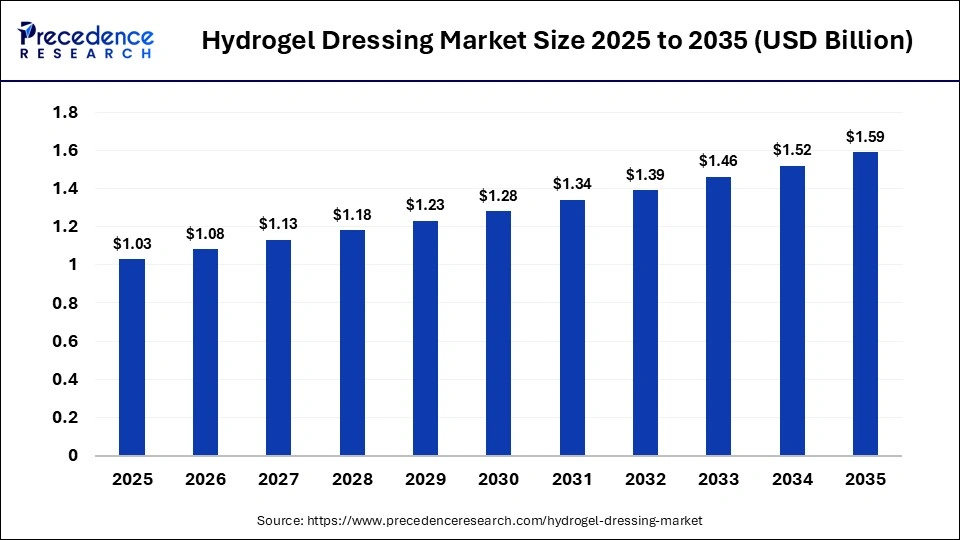
The global hydrogel dressing market size was valued at USD 1.03 billion in 2025 and is projected to grow from USD 1.08 billion in 2026 to approximately USD 1.59 billion by 2035, expanding at a CAGR of 4.36% from 2026 to 2035.
Market growth is largely driven by the rising number of chronic wounds, diabetic patients, and aging populations requiring long-term wound care solutions. Additionally, the growing focus on patient-centered treatment, infection control, and faster wound healing technologies is boosting market demand.
Read Also: L-Alanine Market
Key Takeaways
-
North America dominated the hydrogel dressing market in 2025.
-
Asia-Pacific is expected to grow at the fastest rate between 2026 and 2035.
-
By raw material, synthetic hydrogel dressings held the largest market share in 2025.
-
The natural hydrogel segment is projected to grow rapidly during the forecast period.
-
By product, amorphous hydrogel dominated the market in 2025.
-
The sheet hydrogel segment is expected to expand significantly.
-
By application, chronic wounds accounted for the largest market share in 2025.
-
The acute wound segment is anticipated to grow rapidly in the coming years.
-
By end-user, hospitals and clinics dominated the market in 2025.
-
The home healthcare segment is expected to grow strongly through 2035.
What is the Hydrogel Dressing Market?
Hydrogel dressings are advanced wound care products made from water-based polymer networks, usually consisting of 80–99% water or glycerin. These dressings provide a cooling gel-like texture, which helps relieve pain and maintain moisture around the wound.
Maintaining moisture is essential for wound healing because it:
-
Promotes tissue regeneration
-
Prevents wound dehydration
-
Helps remove dead tissue (debridement)
-
Reduces patient discomfort
Hydrogel dressings are particularly effective for treating:
-
Burn wounds
-
Pressure ulcers
-
Diabetic foot ulcers
-
Surgical wounds
-
Skin tears
These dressings are available in different forms, including amorphous gels, sheets, and gel-impregnated gauze, offering flexibility for various wound types.
Advances in material science have also led to antimicrobial hydrogels, silver-infused formulations, and sensor-integrated dressings that improve infection control and wound monitoring.
Hydrogel Dressing Market Trends
Growing Elderly Population
The global increase in the aging population is one of the primary factors driving demand for hydrogel dressings. Older adults are more likely to develop chronic conditions such as diabetes, which can lead to complications like diabetic foot ulcers and pressure sores requiring advanced wound care.
Antimicrobial and Silver-Infused Hydrogel Dressings
Infection control has become a major priority in wound care. Manufacturers are introducing silver-based hydrogel dressings and antimicrobial polymer formulations that help prevent bacterial growth while maintaining moisture balance.
These advanced dressings are increasingly adopted by hospitals aiming to reduce infection rates and hospital readmissions.
Emergence of Smart Hydrogel Dressings
Hydrogel dressings are evolving into smart wound care systems. Researchers are integrating moisture sensors, pH sensors, and temperature monitoring technologies within hydrogel matrices.
These innovations allow healthcare professionals to monitor wound healing in real time without removing the dressing, minimizing disturbance to healing tissues.
Sustainable and Biocompatible Materials
Healthcare systems are placing greater emphasis on environmentally sustainable medical products. Manufacturers are therefore shifting toward biodegradable hydrogels, plant-based polymers, and eco-friendly packaging solutions.
These innovations not only reduce environmental impact but also improve biocompatibility and patient safety.
Impact of Artificial Intelligence in the Hydrogel Dressing Market
Artificial intelligence (AI) is emerging as a transformative force in advanced wound care technologies.
Researchers are developing AI-integrated conductive hydrogel dressings capable of monitoring multiple wound parameters, including:
-
Temperature
-
pH levels
-
Glucose concentration
-
Pressure levels
-
Pain signals
Machine learning algorithms can analyze this data to predict wound healing stages and detect early signs of infection, achieving diagnostic accuracy of up to 96% in some studies.
Additionally, AI-driven material design is helping scientists develop customized hydrogels by predicting optimal combinations of polymers, crosslinkers, and additives.
This shift toward data-driven wound care solutions represents a major transformation from traditional wound management practices.
Hydrogel Dressing Market Scope
| Report Coverage | Details |
|---|---|
| Market Size in 2025 | USD 1.03 Billion |
| Market Size in 2026 | USD 1.08 Billion |
| Market Size by 2035 | USD 1.59 Billion |
| Growth Rate (2026–2035) | CAGR of 4.36% |
| Dominating Region | North America |
| Fastest Growing Region | Asia Pacific |
| Base Year | 2025 |
| Forecast Period | 2026–2035 |
| Segments Covered | Raw Material, Product, Application, End-User, Region |
Segment Insights
Raw Material Insights
Synthetic Hydrogels
The synthetic hydrogel segment dominated the hydrogel dressing market in 2025. These hydrogels are manufactured using synthetic polymers, offering consistent quality, durability, and controlled absorption.
Synthetic hydrogels are widely preferred by manufacturers because they provide:
-
High mechanical strength
-
Reliable moisture control
-
Large-scale manufacturing capability
These features make them suitable for moderate to heavily exuding wounds.
Natural Hydrogels
The natural hydrogel segment is expected to grow rapidly during the forecast period. Natural hydrogels are derived from biopolymers such as alginate, collagen, and chitosan.
Clinicians prefer these materials because they offer:
-
High biocompatibility
-
Enhanced tissue regeneration
-
Improved interaction with wound beds
These properties make natural hydrogels particularly suitable for regenerative wound care treatments.
Product Insights
Amorphous Hydrogel
The amorphous hydrogel segment held the largest share of the market in 2025. These gel-based dressings are usually packaged in tubes or sachets, allowing easy application to irregular wound surfaces.
Their fluid-like consistency makes them ideal for:
-
Dry wounds
-
Necrotic tissue
-
Deep wound cavities
They also assist in rehydrating non-viable tissue, which accelerates wound healing.
Sheet Hydrogel
The sheet hydrogel segment is expected to grow significantly in the coming years. These dressings provide uniform thickness and moisture distribution, making them convenient for both hospitals and home healthcare.
Sheet hydrogels also provide a cooling effect, which helps relieve pain in burn wounds and inflamed tissues.
Application Insights
Chronic Wounds
The chronic wound segment dominated the hydrogel dressing market in 2025 due to the increasing incidence of:
-
Diabetic foot ulcers
-
Pressure ulcers
-
Venous leg ulcers
Hydrogel dressings are essential in long-term wound care because they maintain consistent hydration and soften necrotic tissue, enabling effective wound healing.
Acute Wounds
The acute wound segment is expected to grow rapidly during the forecast period. The increasing number of surgical procedures and burn injuries worldwide is driving demand for advanced wound care products.
Hydrogel dressings support rapid epithelialization and painless dressing removal, making them ideal for post-surgical recovery.
End-User Insights
Hospitals and Clinics
Hospitals and clinics accounted for the largest share of the hydrogel dressing market in 2025. These healthcare facilities treat a large number of patients with both acute and chronic wounds, leading to strong demand for advanced wound care products.
Hydrogel dressings are often integrated with other treatments such as negative pressure wound therapy.
Home Healthcare
The home healthcare segment is expected to grow rapidly during the forecast period. The shift toward decentralized healthcare and home-based wound management is increasing the demand for easy-to-use wound care products.
Hydrogel dressings designed for home use offer simple application, long wear time, and minimal discomfort, making them suitable for elderly patients.
Regional Insights
North America
North America led the hydrogel dressing market in 2025 due to:
-
A well-established healthcare system
-
High prevalence of diabetes
-
Growing cases of chronic wounds and burns
Healthcare providers in the region actively adopt advanced wound care technologies supported by strong clinical research.
United States
The United States plays a major role in the regional market due to strong demand for advanced wound care products and innovative medical technologies.
An aging population, increasing chronic disease prevalence, and favorable reimbursement policies are supporting market growth.
Asia-Pacific
The Asia-Pacific hydrogel dressing market is expected to grow at the fastest rate between 2026 and 2035.
Market growth is driven by:
-
Expanding healthcare infrastructure
-
Increasing healthcare expenditure
-
Rising number of diabetic patients in countries like India and China
Growing awareness of advanced wound care solutions is also encouraging hospitals to adopt hydrogel dressings.
China
China is witnessing rapid growth in the hydrogel dressing market due to increased healthcare investments and expanding medical device manufacturing capabilities.
Government initiatives to strengthen healthcare infrastructure and improve wound care services are expected to support market expansion.
Key Companies in the Hydrogel Dressing Market
Major companies operating in the hydrogel dressing industry include:
-
Coloplast A/S
-
DeRoyal Industries
-
3M Company
-
Smith & Nephew
-
Laboratoires Urgo (Urgo Medical / Urgo Group)
-
Lohmann & Rauscher GmbH & Co. KG
-
Essity AB (BSN Medical)
-
Integra LifeScience Corporation
-
B. Braun Melsungen AG
-
Scapa Healthcare
-
ConvaTec Group PLC
-
Mölnlycke Health Care AB
Recent Developments
-
October 2024: Kerala University in India patented a patient-specific hydrogel dressing developed using ferulic acid and alginate dialdehyde gelatin for faster healing of diabetic wounds.
-
February 2026: Researchers at the University of Warwick (UK) discovered that stiffer and less hydrated hydrogels can slow bacterial growth, opening new opportunities for infection-resistant wound dressings.
Get Sample PDF: https://www.precedenceresearch.com/checkout/7850
For inquiries regarding discounts, bulk purchases, or customization requests, please contact us at sales@precedenceresearch.com

- Hydrogel Dressing Market Size to Surge USD 1.59 Billion by 2035 - March 16, 2026
- L-Alanine Market Size to Reach USD 288.10 Million by 2035 - March 16, 2026
- Serum Free Media Market Size to Hit USD 9.61 Billion by 2035 - March 16, 2026
