
 by
by Market Overview
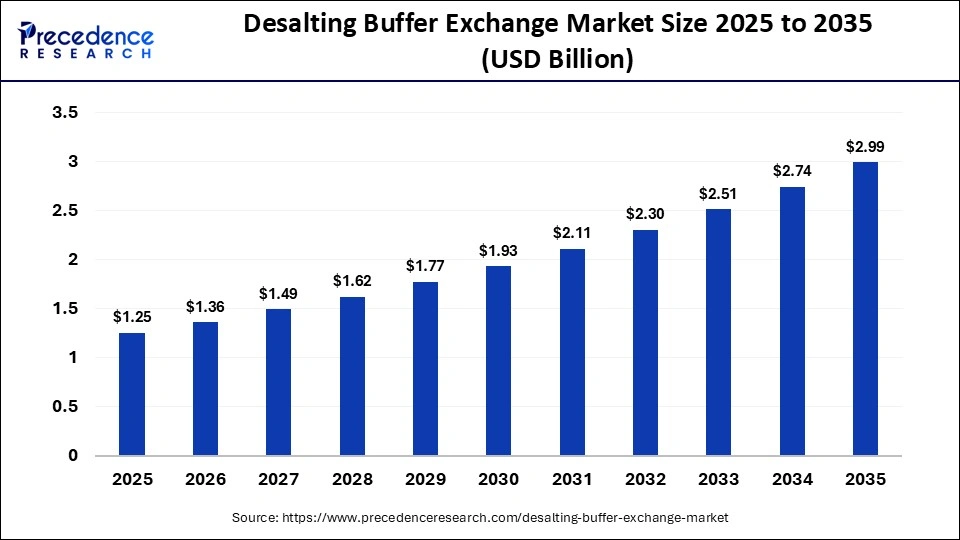
The desalting buffer exchange market is witnessing steady growth, driven by the increasing demand for efficient downstream purification processes in biopharmaceutical manufacturing. The global market size was valued at USD 1.25 billion in 2025 and is projected to grow from USD 1.36 billion in 2026 to approximately USD 2.99 billion by 2035, expanding at a CAGR of 9.10% during the forecast period. Desalting and buffer exchange are critical processes used to remove salts and transfer biomolecules such as proteins into suitable buffers using chromatography and filtration techniques. These processes are essential in maintaining protein stability and ensuring high-quality biologics production. The rising demand for biologics, monoclonal antibodies, and advanced therapeutics is significantly contributing to market expansion, along with increasing approvals of biologics by regulatory bodies.
Read Also: Microservices in Healthcare Market
Impact of AI on the Market
Artificial intelligence is transforming desalting and buffer exchange processes by enabling real-time monitoring and optimization of parameters such as pH levels, conductivity, and membrane performance. AI-driven systems help improve process efficiency, reduce buffer consumption, and maintain protein integrity. Machine learning integration in chromatography and filtration platforms allows predictive maintenance of membranes and columns, minimizing downtime and operational risks. This technological advancement enhances overall productivity and ensures consistent output quality in biomanufacturing facilities.
Market Trends
Several emerging trends are shaping the desalting buffer exchange market. One key trend is the adoption of buffer recycling and circular processing models, which promote sustainability by reducing water usage and operational costs. Another significant trend is the shift toward fully integrated and continuous downstream bioprocessing platforms that combine filtration and chromatography for faster and more efficient processing. Additionally, the growing demand for high-purity protein therapeutics and the expansion of cell and gene therapy pipelines are accelerating the adoption of advanced desalting technologies. These trends collectively highlight the industry’s move toward efficiency, sustainability, and innovation.
Market Scope
| Report Coverage | Details |
| Market Size in 2025 | USD 1.25 Billion |
| Market Size in 2026 | USD 1.36 Billion |
| Market Size by 2035 | USD 2.99 Billion |
| Market Growth Rate from 2026 to 2035 | CAGR of 9.10% |
| Dominating Region | North America |
| Fastest Growing Region | Asia-Pacific |
| Base Year | 2025 |
| Forecast Period | 2026 to 2035 |
| Segments Covered | Product, Technique, Application, End User, and Region |
| Regions Covered | North America, Europe, Asia-Pacific, Latin America, and Middle East & Africa |
Market Dynamics
The growth of the market is primarily driven by the expansion of biosimilars manufacturing pipelines. Increasing approvals of biosimilars across therapeutic areas such as oncology and immunology are placing pressure on purification systems, thereby increasing the demand for effective buffer exchange solutions. However, high capital investment and operational costs associated with advanced desalting technologies act as major restraints, particularly for small and mid-sized biotech firms. On the other hand, continuous advancements in membrane filtration technologies present significant opportunities for the market. Innovations aimed at improving scalability, efficiency, and processing speed are encouraging wider adoption across biomanufacturing facilities.
Product Insights
The product segment of the desalting buffer exchange market is categorized into columns, membrane filters, and kits & reagents, each playing a critical role in purification workflows. Among these, columns dominated the market with a 48% share in 2025 due to their widespread use in rapid and efficient desalting and buffer exchange processes across both research and industrial environments. These column-based systems are highly preferred in laboratories because they offer consistent performance, minimal setup time, and high reproducibility in protein purification steps. Their ability to deliver quick and reliable results makes them ideal for laboratory-scale as well as pilot-scale applications, supporting their strong adoption.
Membrane filters accounted for 28% of the market share in 2025 and are gaining strong traction due to their effectiveness in ultrafiltration and dialysis applications. These systems are widely used by biologics manufacturers because of their scalability and cost-efficiency. Membrane filtration ensures precise separation of proteins from salts and contaminants, maintaining high product quality and consistency, which is crucial in large-scale biologics production.
Meanwhile, kits & reagents held a 24% market share in 2025 and are expected to grow at the fastest rate over the forecast period. This growth is driven by the increasing demand for ready-to-use and convenient purification solutions, particularly in academic research and early-stage drug development. Their ease of use, reduced preparation time, and suitability for small-scale experiments are making them increasingly popular across research laboratories worldwide.
Technique Insights
Based on technique, the market includes size exclusion chromatography (SEC), dialysis, ultrafiltration, and precipitation methods. Among these, size exclusion chromatography (SEC) emerged as the leading technique, capturing a 46% share in 2025. This dominance is attributed to its high precision in separating proteins from salts without affecting their structural integrity. SEC is widely used in biologics processing, where maintaining protein stability is essential. Its reliability and effectiveness have made it a standard method in early-stage biologics workflows and laboratory applications.
Dialysis held the second-largest share of 22% in 2025 and continues to be a preferred method due to its simplicity and cost-effectiveness. It is particularly suitable for laboratory-scale buffer exchange processes and remains a widely adopted approach for researchers seeking economical purification solutions.
Ultrafiltration, with a 20% share in 2025, is expected to witness the fastest growth during the forecast period. This is largely due to its scalability, automation capabilities, and efficiency in handling large sample volumes. As biologics manufacturing expands, the need for high-throughput and time-efficient purification technologies is increasing, positioning ultrafiltration as a key growth driver in the market.
Precipitation methods accounted for 12% of the market share in 2025 and are mainly used in specialized applications. These methods are valued for their simplicity and low operational costs, allowing selective protein isolation based on solubility. Although niche, they remain important in certain research and laboratory processes.
Application Insights
In terms of application, the market is segmented into protein purification, nucleic acid purification, drug development, and others. Protein purification dominated the market with a 50% share in 2025, driven by its critical role in biologics manufacturing and proteomics research. Biopharmaceutical companies rely heavily on buffer exchange processes to maintain protein stability during the production of monoclonal antibodies and recombinant proteins. The complexity of biologics production and the need for consistent product quality continue to drive strong demand in this segment.
Nucleic acid purification accounted for 20% of the market share in 2025 and remains a vital application area due to its extensive use in genomics, molecular biology, and diagnostic research. The growing importance of DNA and RNA analysis, along with increasing demand for research in omics technologies, is supporting steady growth in this segment.
The drug development segment held an 18% share in 2025 and is projected to grow at the fastest rate in the coming years. This growth is fueled by expanding biologics pipelines, increasing complexity of therapeutic molecules, and rising investments in pharmaceutical R&D. Buffer exchange technologies play a key role in ensuring stability and effectiveness during drug formulation and development processes.
Other applications, including diagnostics and proteomics research, accounted for 12% of the market share in 2025. These applications continue to contribute to market growth by supporting specialized research and analytical requirements.
End-User Insights
By end user, the desalting buffer exchange market is led by pharmaceutical and biotechnology companies, which dominated the market in 2025. This dominance is driven by the high demand for efficient and reliable purification processes in biologics manufacturing. These companies depend heavily on buffer exchange technologies to maintain protein stability and ensure high-quality production of complex biologics such as monoclonal antibodies and recombinant proteins. Continuous investments in R&D and expansion of large-scale manufacturing facilities further strengthen this segment’s leadership.
On the other hand, contract research organizations (CROs) are expected to grow at the fastest rate during the forecast period. This growth is primarily driven by the increasing trend of outsourcing biologics development and purification processes by pharmaceutical and biotech companies. CROs provide cost-effective, scalable, and high-quality services without requiring clients to invest in expensive infrastructure. Additionally, the rising number of clinical trials and global research collaborations is significantly boosting demand for CRO-based desalting and buffer exchange services.
Regional Insights
North America led the desalting buffer exchange market in 2025 with a 39% share, driven by a strong biopharmaceutical industry, advanced research infrastructure, and the presence of major market players. The United States remains the key contributor, supported by a robust biologics pipeline and continuous investments in downstream processing technologies. Europe holds the second-largest market share, benefiting from a well-established regulatory framework and strong manufacturing capabilities. Meanwhile, Asia-Pacific is expected to grow at the fastest rate due to rapid expansion of biologics manufacturing facilities, increasing government support, and rising investments in biotechnology. Countries like China are playing a crucial role in driving regional growth through large-scale production capacity expansion and technological advancements.
Segments Covered in the Report
By Product
- Columns
- Spin Columns
- Gravity Columns
- Prepacked Columns
- Membrane Filters
- Ultrafiltration Membranes
- Dialysis Membranes
- Kits & Reagent
- Buffer Exchange Kits
- Desalting Reagents
By Technique
- Size Exclusion Chromatography (SEC)
- Dialysis
- Ultrafiltration
- Precipitation Methods
By Application
- Protein Purification
- Recombinant Proteins
- Antibody Purification
- Nucleic Acid Purification
- DNA/RNA Cleanup
- Drug Development
- Biologics Development
- Vaccine Development
- Others
- Diagnostics
- Proteomics Research
By End User
- Pharmaceutical & Biotechnology Companies
- Biopharma Manufacturers
- Vaccine Producers
- Academic & Research Institutes
- Universities
- Research Labs
- Contract Research Organizations (CROs)
By Region
- North America
- Latin America
- Europe
- Asia-pacific
- Middle and East Africa
Desalting Buffer Exchange Market Companies
- Agilent Technologies, Inc.
- Avantor, Inc.
- Bio-Rad Laboratories, Inc.
- Cytiva (Danaher Corporation)
- GE Healthcare (Cytiva)
- Merck KGaA
- Pall Corporation
- PerkinElmer, Inc.
- Promega Corporation
- Qiagen N.V.
- Repligen Corporation
- Sartorius AG
- Shimadzu Corporation
- Takara Bio Inc.
- Thermo Fisher Scientific Inc.
Get Sample Link: https://www.precedenceresearch.com/sample/8276
For inquiries regarding discounts, bulk purchases, or customization requests, please contact us at sales@precedenceresearch.com

