
 by
by What is the Active Pharmaceutical Ingredients Market Size in 2026?
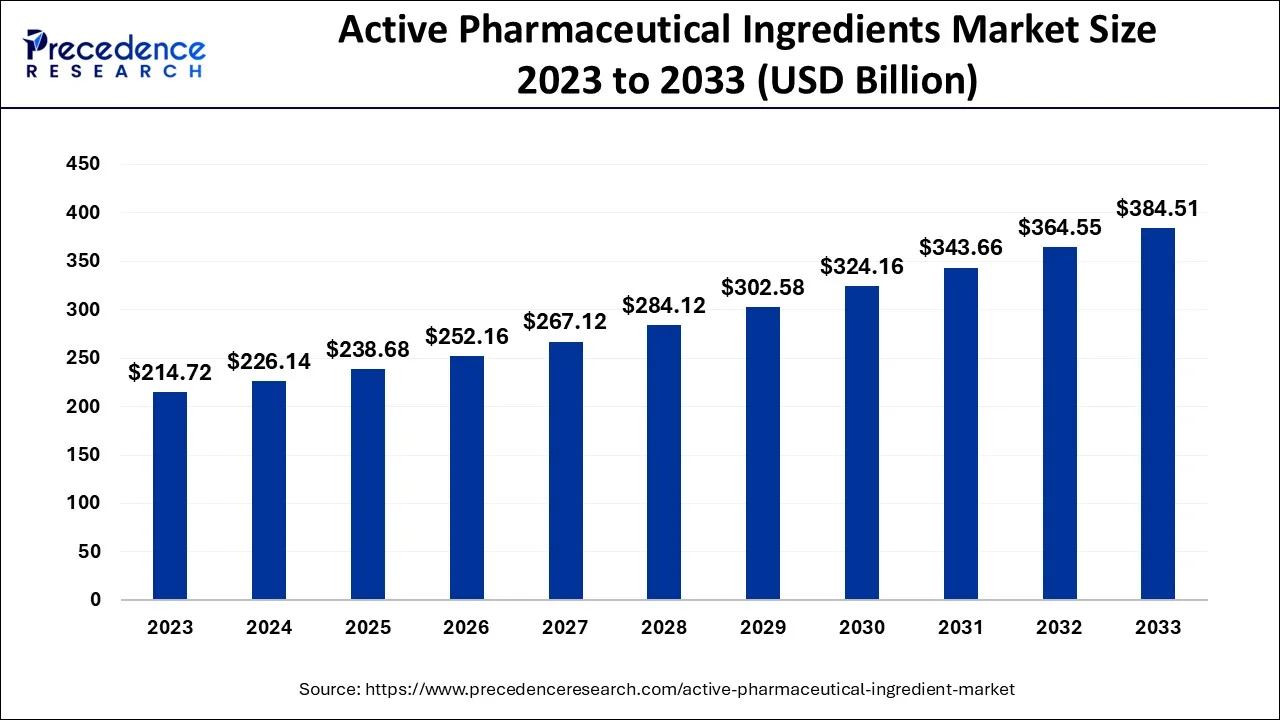
The global active pharmaceutical ingredients (API) market is entering a transformative decade, with its valuation projected to grow from USD 238.68 billion in 2025 to USD 425.26 billion by 2035, expanding at a CAGR of 5.95% from 2026 to 2035.
Driven by the rapid rise in chronic diseases, expansion of generic drug manufacturing, and breakthroughs in biotechnology, the API ecosystem is evolving into a cornerstone of modern pharmaceutical innovation.
Why is the Active Pharmaceutical Ingredients Market Witnessing Accelerated Expansion?
The market is gaining significant traction due to increasing global healthcare demand, particularly for treatments targeting cardiovascular diseases, cancer, diabetes, and neurological disorders. The surge in precision medicine and personalized therapeutics is further reshaping API development pipelines.
Pharmaceutical companies are also leveraging outsourcing and contract manufacturing strategies to reduce costs and accelerate drug development timelines—creating a favorable environment for API manufacturers worldwide.
What Defines the Current Market Landscape?
• The Active Pharmaceutical Ingredients market is valued at USD 238.68 billion in 2025 and is forecasted to reach USD 425.26 billion by 2035, reflecting strong long-term growth.
• North America dominates the global market with a 38.40% share, supported by advanced pharmaceutical infrastructure.
• Asia Pacific is the fastest-growing region, expected to expand at a CAGR of 6.37% due to manufacturing expansion in India and China.
• Synthetic APIs lead the market with over 71% share, while biotech APIs are rapidly gaining momentum.
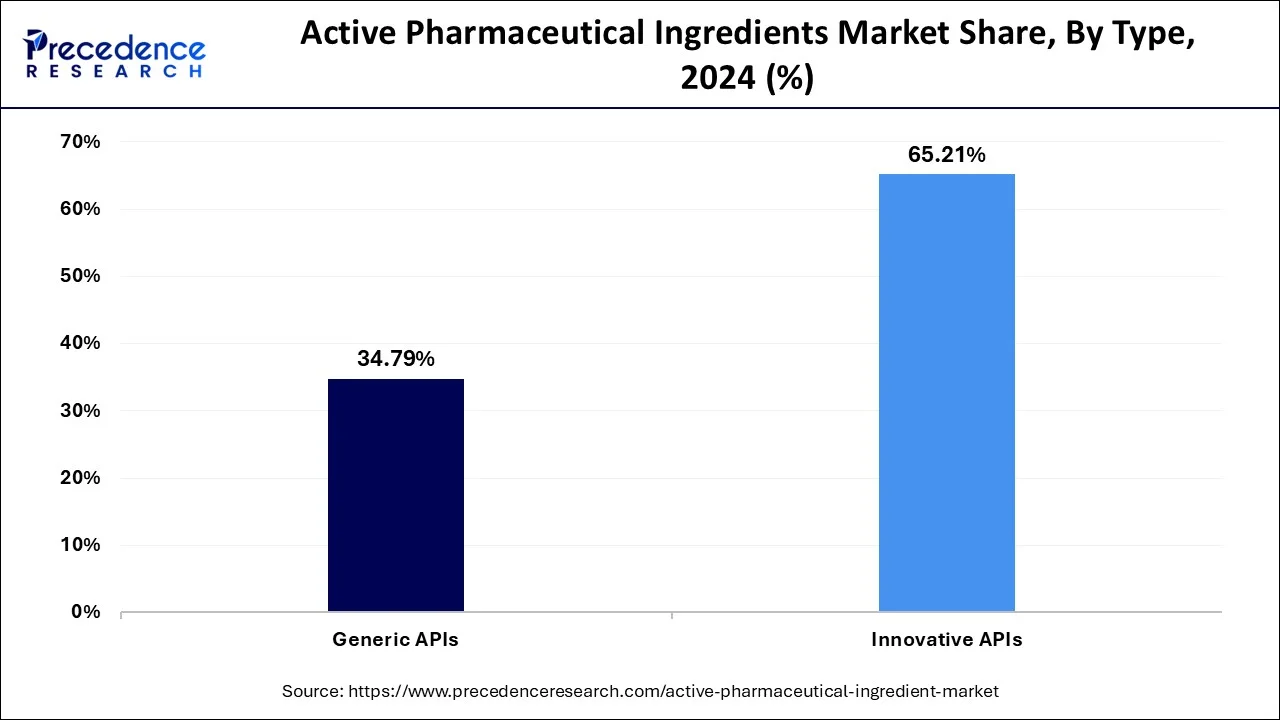
• Innovative APIs hold the largest share (65.11%), reflecting increasing R&D investments in novel drug development.
• Cardiovascular diseases remain the largest application segment, while oncology is emerging as the fastest-growing therapeutic area.
What Role Does Artificial Intelligence Play in the Active Pharmaceutical Ingredients Market?
Artificial intelligence is becoming a critical enabler in API development, particularly in drug discovery and molecular design. AI-driven platforms can rapidly analyze chemical compounds, predict drug interactions, and optimize synthesis pathways—significantly reducing time-to-market for new drugs.
Additionally, AI enhances manufacturing efficiency by improving quality control, predictive maintenance, and supply chain optimization. As regulatory requirements become more stringent, AI-based compliance monitoring systems are helping API manufacturers maintain global quality standards while reducing operational risks.
What are the Key Growth Drivers Shaping the Market?
Rising Chronic Disease Burden
The increasing prevalence of cardiovascular diseases, cancer, and diabetes is creating sustained demand for APIs globally.
Patent Expirations Fueling Generics
The expiration of blockbuster drug patents is enabling widespread production of cost-effective generic APIs.
Expansion of Biopharmaceutical Research
Growing investments in biotechnology are accelerating the development of complex APIs, including biologics and high-potency compounds.
Outsourcing and Cost Efficiency
Pharmaceutical companies are increasingly outsourcing API manufacturing to reduce costs and improve scalability.
MarketScope
| Report Coverage | Details |
| Market Size in 2025 | USD 238.68 Billion |
| Market Size in 2026 | USD 252.16 Billion |
| Market Size by 2036 | USD 425.26 Billion |
| Growth Rate from 2026 to 2035 | CAGR of 5.95% |
| Dominant Region | North America |
| Fastest Growing Region | Asia Pacific |
| Base Year | 2025 |
| Forecast Period | 2026 to 2035 |
| Segments Covered | Type of Synthesis, Type of Manufacturer, Application, Type and Region |
| Regions Covered | North America, Europe, Asia-Pacific, Latin America, and Middle East & Africa |
What Opportunities and Trends Are Emerging in the API Market?
How is Biotech API Transforming Drug Development?
Biotech APIs, including monoclonal antibodies and recombinant proteins, are enabling targeted therapies for complex diseases such as cancer and autoimmune disorders, making them one of the fastest-growing segments.
Why is Asia Pacific Becoming a Manufacturing Hub?
Countries like India and China are offering cost advantages, strong supply chains, and expanding production capacities, attracting global pharmaceutical investments.
Are High-Potency APIs the Next Big Opportunity?
Yes, the growing demand for highly targeted treatments is increasing the adoption of high-potency APIs (HPAPIs), especially in oncology.
Market Dynamics
Type of Synthesis
The synthetic API segment currently dominates the market. This is mainly because chemical synthesis is more cost-effective and scalable. Synthetic APIs are widely used in treating chronic diseases and are commonly outsourced, making them a major contributor to overall revenue especially in contract manufacturing.
On the other hand, biotech APIs are the fastest-growing segment. Rapid advancements in biotechnology and biopharmaceutical research are driving this growth. These APIs are essential for advanced treatments like biologics and antibody-drug conjugates, particularly for complex diseases such as cancer and autoimmune disorders. Their high therapeutic value is attracting significant investment.
Revenue by Type of Synthesis (USD Billion)
• Biotech APIs:
2023: 60.70 → 2024: 64.06 → 2025: 67.75
• Synthetic APIs:
2023: 154.02 → 2024: 162.08 → 2025: 170.93
Type of API
Innovative APIs currently generate higher revenue due to their role in new and patented drugs.
However, generic APIs are growing faster. This growth is fueled by:
• Expiry of patents on major drugs
• Rising demand for affordable medicines
• Increased adoption of biosimilars
This trend is especially strong in developing countries where cost-effective treatments are critical.
Revenue by Type (USD Billion)
• Generic APIs:
2023: 74.50 → 2024: 78.69 → 2025: 83.28
• Innovative APIs:
2023: 140.22 → 2024: 147.45 → 2025: 155.40
Type of Manufacturers
Captive APIs (in-house production) dominate the market. Large pharmaceutical companies prefer producing APIs internally to:
• Maintain quality control
• Reduce costs
• Secure supply chains
Advancements like AI-driven manufacturing are further strengthening this segment.
In contrast, merchant APIs (outsourced production) are the fastest-growing segment. Companies are increasingly outsourcing due to:
• High infrastructure costs
• Need for scalability
• Improved capabilities of contract manufacturers
Governments are also supporting local API production. For example, India has launched initiatives to reduce dependency on imports and boost domestic manufacturing.
Application Insights
Cardiology (Largest Segment)
The cardiology segment leads the market due to the rising global burden of cardiovascular diseases (CVDs). Increasing cases of hypertension, obesity, and unhealthy lifestyles are driving demand for cardiovascular drugs—and therefore APIs.
CVDs account for 17.9 million deaths globally
They represent 32% of all deaths worldwide
This ensures steady and long-term demand for APIs in this segment.
Oncology (Fastest Growing Segment)
The oncology segment is expanding rapidly due to the increasing prevalence of cancer and continuous advancements in targeted therapies and biologics.
• Lung cancer is the most common globally
• Over 35 million cancer cases expected by 2050
Pharmaceutical companies are heavily investing in oncology APIs, including:
• Development of high-potency APIs
• Expansion of manufacturing facilities
• Launch of generic cancer drugs
Type of Drug
• Prescription drugs dominate the market due to their role in treating chronic and complex conditions.
• OTC (over-the-counter) drugs are growing fastest, driven by:
• Self-medication trends
• Preventive healthcare awareness
• Demand for supplements and nutraceuticals
Regional Insights
North America (Largest Market)
North America leads the global API market, driven by:
High healthcare spending
Strong demand for biologics and specialty drugs
Advanced manufacturing technologies
The U.S. alone is expected to grow significantly, reaching nearly USD 79.8 billion by 2035.
Asia Pacific (Fastest Growing Region)
Asia Pacific is the fastest-growing region, especially countries like:
• China
• India
• Japan
Growth drivers include:
• Low production costs
• Availability of raw materials
• Expanding contract manufacturing industry
• Government support and favorable policies
India and China are also the largest API exporters globally, thanks to strong manufacturing capabilities.
Global Trade Highlights (2024)
Top API exporters:
• China: ~USD 35 billion
• India: ~USD 30 billion
• Germany & Switzerland: Focus on high-quality APIs
• U.S. & Italy: Significant contributors
Value Chain Overview
- R&D: Discovery and development of APIs
- Clinical Trials & Approval: Testing safety and effectiveness
- Formulation: Converting APIs into final dosage forms
- Packaging: Ensuring traceability and safety
- Distribution: Supplying to hospitals and pharmacies
Key Companies & Market Share
- Teva Pharmaceutical Industries – Largest API producer globally
- Divi’s Laboratories – Leader in high-volume generic APIs
- Pfizer (CentreOne) – Strong in high-potency and specialized APIs
- Lonza Group – Focused on complex biologics and biotech APIs
These companies use strategies like partnerships, acquisitions, and outsourcing to maintain competitiveness.
Key Takeaways
- Synthetic APIs dominate due to cost advantages
- Biotech APIs are the future, driven by innovation
- Generics are growing rapidly due to affordability
- Captive manufacturing ensures supply security
- Oncology and biologics are major growth drivers
- Asia Pacific is emerging as the global production hub
Active Pharmaceutical Ingredient (API) Market Companies
- Albemarle Corporation
- AurobindoPharma
- Reddy’s Laboratories Ltd.
- AbbVieInc
- Teva Pharmaceutical Industries Ltd.
- Mylan N.V.
- CiplaInc
- BoehringerIngelheim International GmbH
- Merck & Co., Inc
- Sun Pharmaceutical Industries Ltd
- Bristol-Myers Squibb Company
Segments Covered in the Report
By Type of Synthesis
- Biotech
- Monoclonal Antibodies
- Recombinant Proteins
- Vaccines
- Synthetic
By Type of Manufacturer
- Captive APIs
- Merchant APIs
- Generic APIs
- Innovative APIs
By Type
- Generic APIs
- Innovative APIs
By Application
- Cardiovascular Diseases
- Oncology
- CNS & Neurological Disorders
- Orthopedic Disorders
- Endocrinology
- Pulmonology
- Gastrointestinal Disorders
- Nephrology
- Ophthalmology
- Others
By Regional Outlook
- North America
- U.S.
- Canada
- Europe
- U.K.
- Germany
- France
- Asia Pacific
- China
- India
- Japan
- South Korea
- Middle East & Africa
- Latin America
Get Sample : https://www.precedenceresearch.com/sample/1035
Also Read :https://www.pharma-geek.com/bone-resorption-inhibitors-market/

