 by
by RNA-based therapeutics are creating new opportunities across rare diseases, oncology, infectious diseases, genetic disorders, and other chronic conditions. However, as more companies enter clinical development, success depends on more than advancing a promising candidate.
Biotechnology and pharmaceutical companies must understand which RNA modalities are gaining momentum, where competitors are building pipelines, how patent activity is evolving, which therapeutic areas offer whitespace, and how commercialization strategies should begin before regulatory approval.
According to Towards Healthcare, the North America RNA therapy clinical trials sector was valued at USD 1.08 billion in 2025 and is expected to grow from USD 1.12 billion in 2026 to approximately USD 1.57 billion by 2035, expanding at a CAGR of 3.84% from 2026 to 2035.
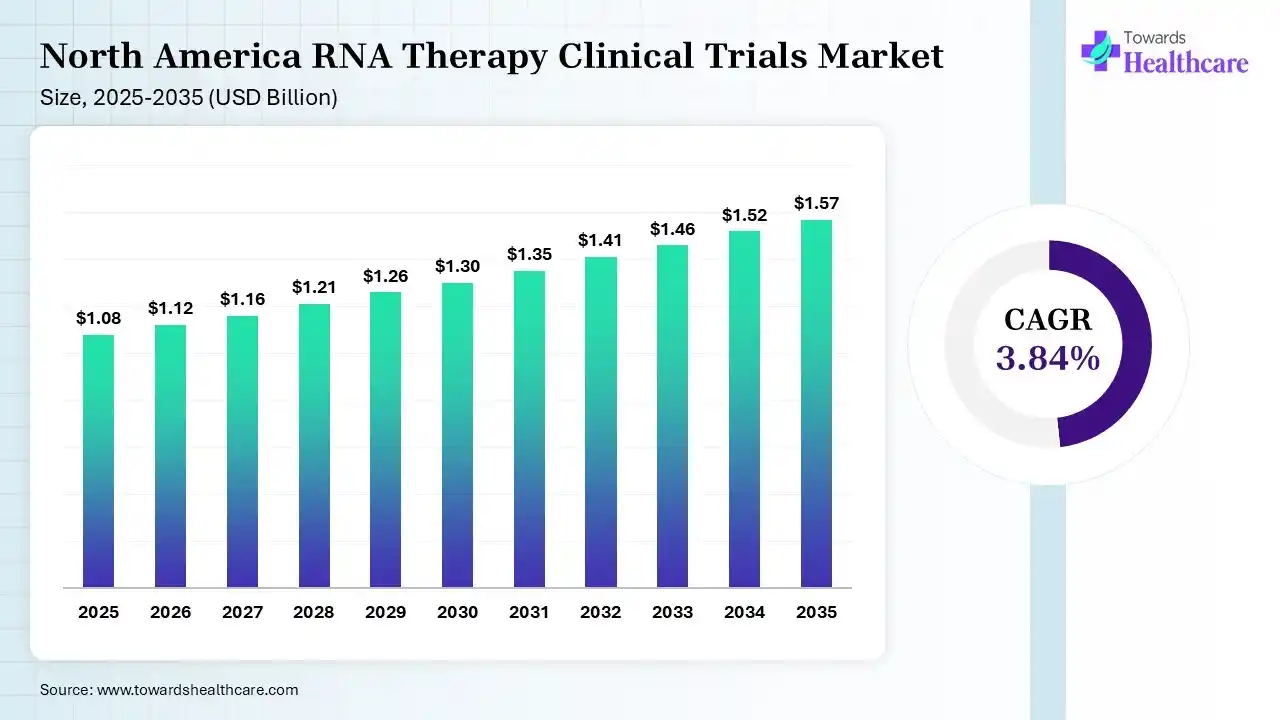
Explore the Full Research Scope: https://www.towardshealthcare.com/download-sample/7054
The growth is being supported by the increasing burden of chronic diseases, growing development of RNA therapeutics for rare diseases, expansion of RNA modalities, and continued activity from companies including Moderna, Alnylam Pharmaceuticals, Ionis Pharmaceuticals, Arrowhead Pharmaceuticals, and Regeneron Pharmaceuticals.
North America RNA Therapy Clinical Trials at a Glance
- USD 1.08 billion: Sector size in 2025
- USD 1.12 billion: Estimated size in 2026
- USD 1.57 billion: Projected size by 2035
- 3.84% CAGR: Expected growth from 2026 to 2035
- 85.50%: U.S. revenue share in 2025
- 14.50%: Canada’s share in 2025
- 37.80%: Messenger RNA segment share in 2025
- 27.40%: RNA interference segment share in 2025
- 4.65% CAGR: Expected growth of the RNA interference segment
- 42.60%: Phase II clinical trial share in 2025
- 24.80%: Phase I share in 2025
- 4.55% CAGR: Expected growth of Phase I
- 22.40%: Rare diseases’ share in 2025
- 18.90%: Anticancer segment share in 2025
- 5.05% CAGR: Expected growth of anticancer applications
These figures indicate that the competitive landscape is becoming increasingly diversified across modality, clinical stage, therapeutic area, and geography.
The U.S. Remains the Center of RNA Clinical Development
The U.S. accounted for 85.50% of the North American sector in 2025, making it the primary center for RNA therapy clinical development in the region.
This concentration creates major opportunities, but it also increases competitive pressure. Companies operating in the U.S. need to monitor not only large pharmaceutical organizations but also emerging biotechnology companies developing specialized RNA platforms.
Canada accounted for 14.50% in 2025 and is projected to grow at the fastest country-level CAGR of 3.50% during the forecast period.
For companies planning North American expansion, this creates an important GTM consideration:
The U.S. may be the largest immediate commercial and clinical opportunity, while Canada can represent an additional growth market for clinical development, research partnerships, and geographic diversification.
Modality Competition: mRNA Leads, While RNAi Gains Speed
By modality, messenger RNA held the largest share at 37.80% in 2025.
The dominance of mRNA reflects its broad applications and the increased attention generated by the commercial and clinical success of RNA-based technologies.
However, RNA interference accounted for 27.40% of the sector in 2025 and is projected to expand at the fastest CAGR of 4.65%.
This creates an important competitive distinction.
The mRNA Competitive Challenge
The mRNA space is becoming increasingly competitive. Companies need differentiation through:
- Novel delivery technologies
- Improved stability
- Targeted tissue delivery
- New therapeutic applications
- Better tolerability
- Stronger manufacturing capabilities
Major innovators such as Moderna continue to influence expectations around mRNA platform development.
The RNAi Opportunity
RNAi’s projected 4.65% CAGR suggests growing interest in its ability to silence disease-related genes.
Companies such as Alnylam and Arrowhead represent important competitors in this area. New entrants therefore need to evaluate whether they can differentiate through:
Target selection → Delivery → Potency → Dosing frequency → Safety → Intellectual property
This is where competitive intelligence becomes essential.
Why Phase II Is the Most Important Competitive Battlefield
The Phase II segment accounted for 42.60% of the North America RNA therapy clinical trials sector in 2025, making it the largest clinical trial phase.
This is strategically important because Phase II often becomes a major validation point for biotechnology companies.
At this stage, companies are competing for:
- Clinical differentiation
- Investor confidence
- Pharmaceutical partnerships
- Licensing opportunities
- Larger clinical development funding
Meanwhile, Phase I accounted for 24.80% in 2025 and is expected to grow at the fastest CAGR of 4.55%.
This suggests continued expansion of early-stage RNA innovation.
For investors and business-development teams, a growing Phase I pipeline can be particularly valuable because it helps identify future competitors and potential partnership targets before they become expensive late-stage assets.
Rare Diseases Lead, but Oncology Is the Faster-Growing Opportunity
Rare diseases held the largest therapeutic-area share at 22.40% in 2025.
RNA technologies can be particularly relevant for diseases driven by specific genetic or molecular mechanisms, making rare diseases an important strategic focus.
However, the anticancer segment accounted for 18.90% in 2025 and is expected to grow at the fastest CAGR of 5.05%.
This makes oncology one of the most important areas to monitor.
For companies building future pipelines, the strategic question is:
Should the company compete in an established rare-disease opportunity or enter the faster-growing but increasingly competitive oncology segment?
The answer requires combining:
Disease burden + scientific feasibility + competitor density + clinical pipeline activity + patent landscape + commercial potential
Competitor Analysis: Who Is Shaping the RNA Therapy Race?
Moderna
Moderna remains one of the most influential companies in mRNA technology.
Its competitive advantage includes extensive experience with mRNA platforms and manufacturing capabilities. Emerging companies competing in this area need to identify clear technology differentiation rather than simply entering established applications.
Alnylam Pharmaceuticals
Alnylam Pharmaceuticals is a major force in RNA interference.
Its experience in RNAi therapeutics makes it an important benchmark for companies developing gene-silencing approaches.
Potential areas of competition include:
- New targets
- Tissue-specific delivery
- Improved conjugates
- Better safety
- Longer-lasting activity
Ionis Pharmaceuticals
Ionis Pharmaceuticals has established deep expertise in antisense oligonucleotide technology.
Its broad platform and partnership activity make it important for companies analyzing ASO patent and development competition.
Arrowhead Pharmaceuticals
Arrowhead Pharmaceuticals is a significant RNAi-focused innovator.
Its activities should be monitored for competitive developments involving targeted RNA delivery and gene silencing.
Regeneron Pharmaceuticals
Regeneron Pharmaceuticals represents the strategic importance of large biopharmaceutical companies expanding advanced therapeutic capabilities through internal innovation and partnerships.
Patent Competition: The Next RNA Battleground
RNA therapy competition is not limited to clinical trials.
Companies are increasingly competing around:
- RNA sequences
- Target selection
- Chemical modifications
- Delivery technologies
- Lipid nanoparticles
- Conjugate technologies
- Formulations
- Manufacturing processes
- Tissue targeting
- RNA editing platforms
A company may develop a clinically differentiated therapy but still face significant challenges if its technology operates in a crowded patent landscape.
What Companies Should Track
A complete patent intelligence strategy should monitor:
Patent applications → Granted patents → Patent families → Assignees → Technology clusters → Key claims → Geographic coverage → Expiration dates
This can help identify three major opportunities.
Patent Whitespace
Which technologies or therapeutic applications have relatively low patent density?
Licensing Opportunities
Which protected technologies could be accessed through licensing rather than developed internally?
Competitive Risk
Where could overlapping claims create potential freedom-to-operate challenges?
For RNA therapy companies, patent intelligence should therefore be integrated into pipeline selection and GTM planning, not left until the final stages of product development.
RNA Therapy Pipeline Strategy for 2026
The strongest pipeline strategy should not focus only on adding more candidates.
Instead, companies should evaluate:
Scientific potential + Competitive density + Patent position + Clinical feasibility + Commercial opportunity
Priority One: Identify Fast-Growing Modalities
With mRNA holding 37.80% of the sector and RNAi projected to grow at the fastest modality CAGR of 4.65%, companies need to monitor both established and fast-growing technology segments.
Priority Two: Track Early-Stage Innovation
Phase I is projected to grow at 4.55%, making early-stage trial intelligence increasingly valuable.
Tracking early-stage companies can help organizations identify:
- Acquisition targets
- Licensing opportunities
- Future competitors
- Emerging technology platforms
Priority Three: Watch Oncology
The anticancer segment’s projected 5.05% CAGR makes it the fastest-growing therapeutic area identified in the analysis.
Companies considering oncology should assess the competitive landscape before selecting targets.
Priority Four: Build Platform Value
A single successful candidate creates value.
However, a scalable RNA technology platform can potentially support:
Multiple targets → Multiple indications → Multiple partnerships → Multiple revenue opportunities
This can create a stronger long-term business-development story.
GTM Strategy: How RNA Therapy Companies Can Build Competitive Advantage
An RNA therapy GTM strategy should begin well before commercial launch.
Scientific GTM
During early development, companies should build visibility among:
- Researchers
- Academic institutions
- Key opinion leaders
- Principal investigators
- Patient advocacy groups
The message should focus on:
Why is this technology scientifically differentiated?
Partnering GTM
As the pipeline advances, companies should target:
- Pharmaceutical companies
- Strategic investors
- Venture capital firms
- Business-development teams
- Licensing partners
The positioning should communicate:
Technology platform + Pipeline differentiation + IP position + Clinical potential
Commercial GTM
Before approval, companies should understand:
Patient population → Treating physicians → Treatment pathway → Payer requirements → Distribution model
This allows launch teams to prepare evidence and access strategies earlier.
Launch Strategy: Start Before Approval
A strong launch strategy can be divided into three stages.
24–36 Months Before Launch
Focus on:
- Disease epidemiology
- Patient journey mapping
- KOL identification
- Competitor analysis
- Patent monitoring
- Market access planning
12–24 Months Before Launch
Develop:
- Medical affairs strategy
- Payer evidence strategy
- Pricing scenarios
- Geographic prioritization
- Launch messaging
- Partnership strategy
Launch Readiness
Measure:
Physician awareness → Patient identification → Payer access → Treatment capacity → Competitive response
Companies should also develop competitive scenarios.
For example:
What if a competitor enters the same indication first?
What if another RNA modality shows stronger clinical data?
What if a competitor receives faster regulatory approval?
Preparing these scenarios early can reduce launch risk.
How Towards Healthcare Can Help Generate More Leads
Towards Healthcare can use its North America RNA Therapy Clinical Trials intelligence to develop a stronger lead-generation ecosystem for biotechnology and pharmaceutical decision-makers.
Instead of offering only static industry information, Towards Healthcare can help companies access strategic intelligence.
RNA Therapy Competitor Intelligence
Track leading companies and emerging innovators across:
Modality + Pipeline + Clinical phase + Indication + Partnerships + Funding + Launch activity
Patent Competition Intelligence
Provide research covering:
Patent filings + Patent families + Key assignees + Technology clusters + Whitespace opportunities + Licensing potential
Pipeline Tracking
Monitor development from:
Preclinical → Phase I → Phase II → Phase III → Regulatory milestones
This is especially relevant as Phase II represented 42.60% of the sector in 2025, while Phase I is projected to grow at 4.55%.
GTM Intelligence
Help companies understand:
- Competitive positioning
- Target therapeutic areas
- Geographic opportunities
- Partnership activity
- Commercial risks
- Launch opportunities
Launch Intelligence
Track:
Clinical results → Regulatory milestones → Product launches → Partnerships → M&A → Licensing → Patent developments
Strong Lead Generation CTA
Looking to identify your next RNA therapy opportunity?
Towards Healthcare provides customized intelligence on RNA therapy clinical trials, competitor activity, patent landscapes, product pipelines, GTM strategies, partnerships, and launch opportunities to help biotechnology and pharmaceutical companies make faster, data-driven strategic decisions.
Explore our dedicated North America RNA Therapy Clinical Trials research to access deeper industry intelligence and identify emerging opportunities before the competitive landscape becomes more crowded.
Expert View by Payal Rabde – highlighting the trends shaping the future of healthcare.
Explore the latest healthcare insights, all in one dashboard: https://www.towardshealthcare.com/access-dashboard
About Us
Pharma Geek is a part of Towards Healthcare Research & Consulting which is a global healthcare market research and consulting firm dedicated to helping businesses make informed decisions through reliable market intelligence and strategic insights. We serve pharmaceutical, biotechnology, medical device, AI in healthcare, cell and gene therapy, digital health, and life sciences organizations with in-depth market research, custom consulting, competitive analysis, and growth forecasts. Our team combines industry expertise with rigorous research to deliver clear, actionable insights that support market expansion, product strategy, investment decisions, and long-term business growth. From emerging innovations to established healthcare markets, we help organizations understand where the industry is today and where it’s headed tomorrow.
You can place an order or ask any questions, please feel free to contact us at [email protected]
Europe Region – +44 778 256 0738
North America Region – +1 8044 4193 44
APAC Region: +91 9356 9282 04
Visit Our Website: Towards Healthcare Research & Consulting – Expert Consulting Solutions & Research Reports
Find us on social platforms: LinkedIn | Twitter | Instagram | Medium
