 by
by Biotechnology is moving rapidly from research laboratories into commercial-scale drug development, creating strong demand for companies that can support cell and gene therapies, monoclonal antibodies, recombinant proteins, vaccines, viral vectors, and other complex biologics.
For biotech companies, discovering a promising molecule is only the beginning. The bigger challenge is converting that discovery into a repeatable, scalable, regulatory-compliant manufacturing process. This is where contract development and manufacturing organizations (CDMOs) have become increasingly important.
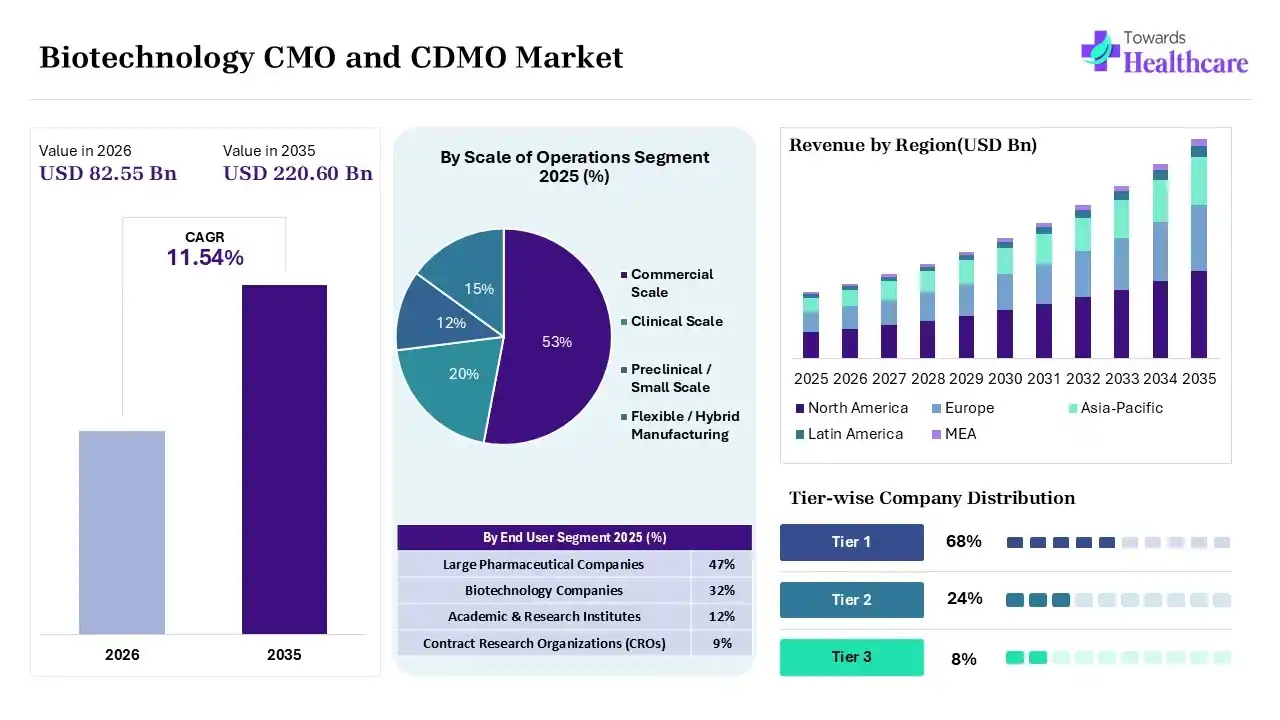
According to Towards Healthcare, the global biotechnology CMO and CDMO market is projected to grow at an 11.54% CAGR through 2035, with North America accounting for approximately 42% of the market.
Access Our Research Insights : https://www.towardshealthcare.com/download-sample/6253
So, which companies are leading this space?
Leading Biotech CDMO Companies
Based on Towards Healthcare’s competitive analysis, several companies stand out:
- Lonza
- Thermo Fisher Scientific (Patheon)
- Boehringer Ingelheim BioXcellence
- Samsung Biologics
- AGC Biologics
- Rentschler Biopharma
- FUJIFILM Diosynth Biotechnologies
- WuXi Biologics
- KBI Biopharma
- Charles River Laboratories
- Catalent
- Recipharm
- Ajinomoto Bio-Pharma Services
Towards Healthcare identifies Lonza as a leading pure-play biotech CDMO, with capabilities spanning biologics development, commercial manufacturing, and cell and gene therapy.
1. Lonza: A Major End-to-End Biotech CDMO
Lonza is one of the most prominent companies in the global biotech CDMO ecosystem.
Its capabilities cover:
Biologics development → Process development → Clinical manufacturing → Commercial manufacturing → Cell & gene therapy
This end-to-end capability is particularly valuable for emerging biotech companies that may not have their own large-scale manufacturing infrastructure.
Towards Healthcare identifies Lonza as a Tier 1 company and describes it as the world’s largest pure-play biotech CDMO.
For biotech buyers, the attraction is clear: instead of coordinating multiple vendors for development and manufacturing, companies can potentially work with a partner capable of supporting several stages of the product lifecycle.
2. Thermo Fisher Scientific: Scale + Biologics Manufacturing
Thermo Fisher Scientific, through Patheon and its biologics businesses, is another major player.
Its capabilities extend across pharmaceutical development, biologics manufacturing, cell and gene therapy, viral vectors, and clinical supply.
Towards Healthcare lists Thermo Fisher Scientific (Patheon) among the leading biotechnology CMO/CDMO companies.
Its major advantage is scale.
For biotech companies moving from early development toward commercial production, access to a large global manufacturing and scientific infrastructure can be particularly valuable.
3. Samsung Biologics: Large-Scale Biologics Manufacturing
Samsung Biologics has become one of the most significant global biologics manufacturing companies.
Its capabilities include:
- Monoclonal antibodies
- Biologics development
- Drug substance manufacturing
- Drug product manufacturing
- Fill-finish
- Analytical services
Towards Healthcare includes Samsung Biologics among the leading CDMO companies in the broader pharma and biotech CDMO landscape.
Its competitive advantage is particularly relevant for companies requiring large-scale biologics manufacturing capacity.
4. Boehringer Ingelheim BioXcellence
Boehringer Ingelheim BioXcellence is another major biotech manufacturing partner.
Its expertise is particularly relevant to biologics and complex biopharmaceutical production.
Towards Healthcare includes Boehringer Ingelheim BioXcellence among the leading biotechnology CMO/CDMO companies.
The company is attractive to biotech developers looking for a partner with established expertise in complex biological manufacturing and process development.
5. FUJIFILM Diosynth Biotechnologies
FUJIFILM Diosynth Biotechnologies has developed a strong position in biologics, vaccines, cell therapy, and gene therapy manufacturing.
Its capabilities span development through commercial manufacturing.
Towards Healthcare lists FUJIFILM Diosynth among major participants in the CDMO ecosystem.
This is particularly important as the industry moves toward increasingly complex modalities that require specialized manufacturing platforms.
6. AGC Biologics
AGC Biologics is another major biologics CDMO supporting companies across development and manufacturing.
Its capabilities include:
Protein therapeutics + monoclonal antibodies + cell and gene therapy + microbial manufacturing
Towards Healthcare lists AGC Biologics among the leading biotechnology CMO/CDMO companies.
Its positioning is especially relevant for biotech companies that need specialized biological manufacturing rather than conventional small-molecule production.
7. Charles River Laboratories
Charles River Laboratories is particularly interesting because its capabilities extend beyond conventional manufacturing.
The company operates across areas including:
- Drug discovery
- Preclinical research
- Cell and gene therapy
- Biologics
- Manufacturing support
Towards Healthcare includes Charles River Laboratories’ Biologics CDMO unit among the leading companies in the biotechnology CMO/CDMO landscape.
For emerging biotech companies, the ability to connect development and manufacturing services can reduce complexity in the transition toward clinical development.
Government Data Shows Why Biotech Manufacturing Matters
The growth of biotech CDMOs is closely connected to the increasing number of biological products moving through regulatory development.
The FDA’s Center for Biologics Evaluation and Research (CBER) maintains a dedicated regulatory pathway for biologics license applications (BLAs). A BLA must provide sufficient information for the FDA to evaluate a biological product’s safety, effectiveness, and manufacturing quality.
The FDA’s 2025 BLA approval records show approvals spanning products such as vaccines, gene therapies, blood products, and other biological products.
This matters for CDMOs because manufacturing isn’t simply about producing a drug at scale.
It must also demonstrate:
Process consistency + Quality control + Manufacturing validation + Regulatory compliance
NIH Investment Is Supporting a Large Biotech Ecosystem
Government research funding also provides an important indicator of the scale of the U.S. biotechnology ecosystem.
The National Institutes of Health (NIH) awarded $35.3 billion in competing and noncompeting extramural grants during FY2025. The NIH’s total FY2025 appropriation was $48.5 billion.
This investment supports biomedical research across universities, research institutions, hospitals, and emerging technology ecosystems.
For CDMOs, this creates a long-term pipeline:
Public research → Biotech discovery → Preclinical development → Clinical trials → Commercial manufacturing
As more research programs mature into therapeutic candidates, demand for specialized development and manufacturing infrastructure can increase.
Lonza vs. Thermo Fisher: Two Different Strengths
Lonza is particularly strong as a dedicated CDMO with deep expertise in biologics and advanced therapies.
Thermo Fisher Scientific combines CDMO capabilities with a much broader life-science ecosystem, including research tools, laboratory services, and manufacturing.
In simple terms:
Lonza → Specialized CDMO expertise + biologics + advanced therapies
Thermo Fisher → CDMO scale + broader life-science infrastructure
For biotech companies, the better partner depends on the complexity of the product, development stage, manufacturing requirements, geographic needs, and desired commercial scale.
Samsung Biologics vs. AGC Biologics
Samsung Biologics has developed a strong reputation for large-scale biologics manufacturing and global capacity.
AGC Biologics offers a broader specialized biologics platform covering multiple technologies and development stages.
The buyer decision therefore depends heavily on the product.
A company developing a high-volume monoclonal antibody may prioritize commercial-scale capacity, while an emerging biotech developing a specialized biologic may prioritize flexibility and technical expertise.
What Do Biotech Buyers Actually Want From CDMOs?
For biotech companies, choosing a CDMO is not simply about finding the company with the largest manufacturing facility.
The most important requirements often include:
1. Regulatory experience
Can the CDMO support FDA and other regulatory requirements?
2. Manufacturing scalability
Can the process move from laboratory scale to clinical and commercial production?
3. Technical expertise
Does the CDMO understand the specific modality?
For example:
mAbs ≠ viral vectors ≠ cell therapies ≠ recombinant proteins
Each requires different manufacturing expertise.
4. Quality systems
Biotech buyers need robust quality systems, analytical testing, validation, and documentation.
5. Speed
For emerging biotech companies, delays in process development or manufacturing can directly affect clinical timelines.
6. Capacity availability
Manufacturing slots can become a major constraint as demand for biologics and advanced therapies increases.
7. End-to-end support
Companies increasingly prefer partners that can support multiple stages rather than managing numerous specialized vendors.
The Industry Is Moving Toward Complex Biologics
One of the biggest changes in the CDMO industry is the increasing complexity of therapeutic products.
Traditional biologics remain important, but CDMOs are also investing heavily in:
- Cell therapies
- Gene therapies
- Viral vectors
- mRNA
- Recombinant proteins
- Bispecific antibodies
- ADC-related manufacturing
- Personalized therapies
The FDA’s recent biologics approvals demonstrate that the regulatory pipeline includes increasingly diverse biological products.
This creates an important competitive advantage for CDMOs that can support multiple modalities under one organization.
Explore the latest healthcare insights, all in one dashboard: https://www.towardshealthcare.com/access-dashboard
Towards Healthcare’s View
According to Towards Healthcare, the biotechnology CMO and CDMO landscape is highly competitive, with Tier 1 companies accounting for approximately 68% of market influence, followed by Tier 2 at 24% and Tier 3 at 8%.
The report identifies North America as the leading region, with approximately 42% share, supported by the presence of major biotechnology and pharmaceutical organizations and a skilled workforce.
This makes the U.S. particularly important for biotech CDMO partnerships.
For biotech companies, investors, and healthcare organizations, Towards Healthcare’s research provides a useful framework for assessing competitive positioning, manufacturing capabilities, technology platforms, and regional opportunities.
Payal Rabde’s Expert Insights – connecting healthcare trends with emerging industry opportunities.
About Us
Pharma Geek is a part of Towards Healthcare Research & Consulting which is a global healthcare market research and consulting firm dedicated to helping businesses make informed decisions through reliable market intelligence and strategic insights. We serve pharmaceutical, biotechnology, medical device, AI in healthcare, cell and gene therapy, digital health, and life sciences organizations with in-depth market research, custom consulting, competitive analysis, and growth forecasts. Our team combines industry expertise with rigorous research to deliver clear, actionable insights that support market expansion, product strategy, investment decisions, and long-term business growth. From emerging innovations to established healthcare markets, we help organizations understand where the industry is today and where it’s headed tomorrow.
You can place an order or ask any questions, please feel free to contact us at [email protected]
Europe Region – +44 778 256 0738
North America Region – +1 8044 4193 44
APAC Region: +91 9356 9282 04
Visit Our Website: Towards Healthcare Research & Consulting – Expert Consulting Solutions & Research Reports
Find us on social platforms: LinkedIn | Twitter | Instagram | Medium
