 by
by Medical alert technology is moving beyond the traditional emergency button. Hospitals, senior-care organizations, assisted-living providers, home-health companies, and caregivers are increasingly looking for systems that can combine emergency response, fall detection, wearable connectivity, GPS, two-way communication, and caregiver alerts.
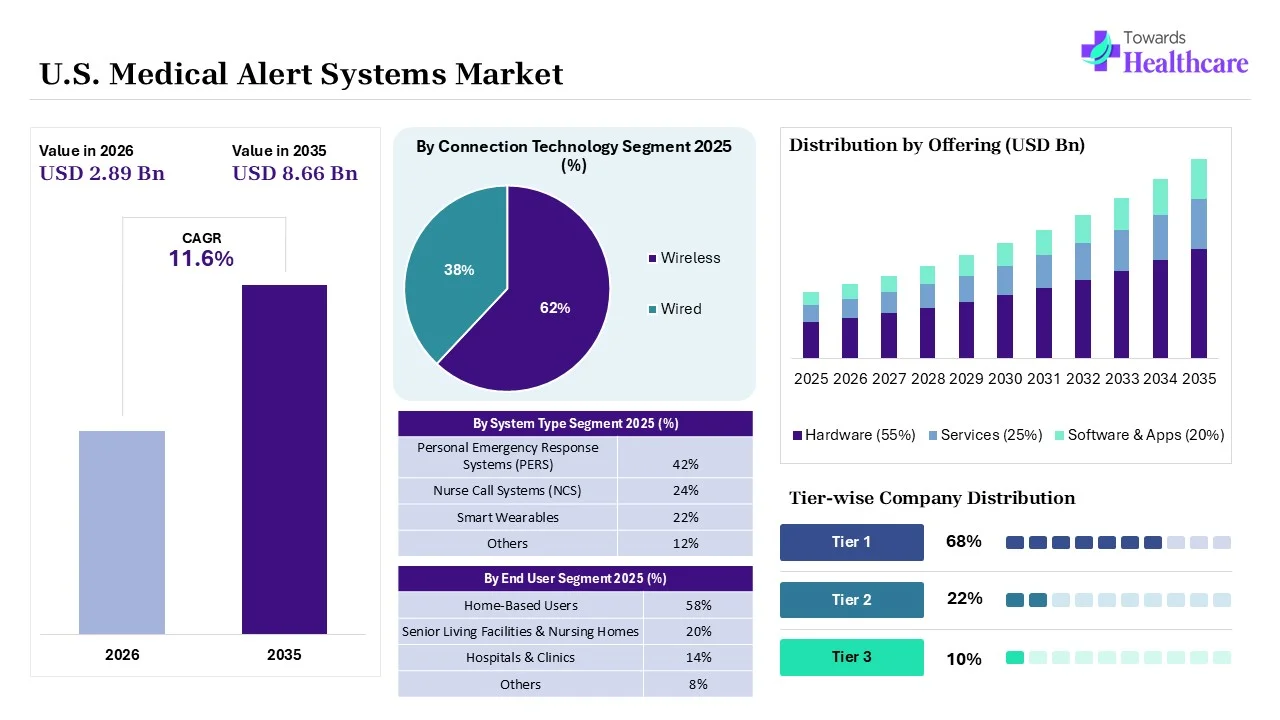
The opportunity is becoming substantial. According to Towards Healthcare, the U.S. medical alert systems market was valued at approximately USD 2.89 billion in 2025 and is projected to reach USD 8.66 billion by 2035, expanding at a 11.60% CAGR from 2026 to 2035.
Explore Our Research Sample: https://www.towardshealthcare.com/download-sample/6094
This growth raises an important question for healthcare buyers:
Which companies are actually building medical alert technology capable of supporting hospital, clinical, and professional-care environments?
Why Medical Alert Technology Matters to Healthcare Providers
Medical alert systems are increasingly becoming part of the broader connected-care ecosystem.
The need is particularly clear among older adults.
According to the CDC, more than 14 million U.S. adults aged 65 and older—about 1 in 4—report falling each year. About 37% of those who fall report an injury requiring medical treatment or restricting activity for at least one day, resulting in an estimated 9 million fall injuries annually.
The consequences can be serious:
- Approximately 3 million emergency department visits occur annually because of older-adult falls.
- Around 1 million older adults are hospitalized following falls each year.
- Nearly 319,000 older adults are hospitalized for hip fractures annually.
- Falls are the leading cause of traumatic brain injuries among older adults.
For healthcare organizations, these numbers make rapid emergency detection and response more than a convenience they can become an important component of patient safety and care coordination.
The Medical Alert Market Is Moving Toward Connected Technology
Towards Healthcare’s analysis shows that the U.S. medical alert systems market is developing across several technologies and end-user categories. Personal emergency response systems (PERS) represented the leading system type in 2025, while wireless technology accounted for approximately 62% of the market. Hardware represented about 55%, and home-based users accounted for approximately 58% of the market.
At the same time, the software and apps segment is expected to grow at the fastest rate, while hospitals and clinics are projected to be the fastest-growing end-user segment.
That shift is significant.
The next generation of medical alert technology is increasingly about:
Wearable device → Wireless connectivity → Emergency detection → Monitoring center → Caregiver/clinical notification → Response
Which Companies Stand Out?
Towards Healthcare identifies several important participants in the U.S. medical alert systems landscape, including Philips Lifeline, ADT Health, Connect America, Bay Alarm Medical, Medical Guardian, LifeStation, MobileHelp, Lively, Life Alert, LogicMark, QMedic, and VRI.
Among these, several are particularly relevant when evaluating technology for professional healthcare environments.
Philips Lifeline: A Major Healthcare-Oriented Name
Philips Lifeline is one of the most established names in medical alert technology.
Its relevance comes from its long-standing focus on emergency response and senior safety rather than simply consumer security.
For healthcare organizations, an established monitoring infrastructure can be particularly important because medical alert technology has to work when a patient is unable to reach a phone or manually explain what has happened.
Philips Lifeline vs. Medical Guardian
Philips Lifeline has the advantage of long-standing recognition in medical alert and senior-care services, while Medical Guardian has developed a stronger modern wearable and mobile-device proposition.
For hospitals and senior-care organizations, Philips may be attractive where established emergency-response infrastructure is the priority. Medical Guardian can be compelling when buyers prioritize mobility, GPS-enabled devices, and wearable technology.
Medical Guardian: Strong Focus on Modern Wearables
Medical Guardian is another significant player identified by Towards Healthcare.
The company offers medical alert devices designed around different mobility and lifestyle requirements, including wearable and mobile solutions.
This is particularly relevant because medical alert technology is moving away from the idea that an individual must remain inside the home.
A patient may be:
At home → Walking outdoors → Visiting a clinic → Traveling → Living in assisted care
and still require emergency connectivity.
Medical Guardian vs. Life Alert
Medical Guardian emphasizes modern mobile and wearable technology, while Life Alert is one of the best-known legacy emergency-response brands.
For technology-oriented healthcare buyers, the comparison is therefore less about brand recognition and more about mobility, connectivity, fall detection, monitoring, and integration with care workflows.
ADT Health: Bringing Security Infrastructure Into Healthcare
ADT Health is another notable name in the medical alert ecosystem.
ADT’s broader security and monitoring infrastructure provides a foundation for emergency-response services.
This creates an interesting distinction:
Traditional medical alert provider → healthcare-focused emergency response
versus
Security/monitoring company → emergency response + connected safety infrastructure
For assisted-living organizations and home-based care providers, that broader monitoring capability can be valuable.
ADT Health vs. Philips Lifeline
ADT Health brings extensive experience in security and monitoring infrastructure, while Philips Lifeline has a more established identity around medical alert and senior-care services.
For buyers, the decision should focus on monitoring capabilities, device options, response protocols, and how the system fits into the organization’s existing care environment.
Connect America: Infrastructure for Connected Care
Connect America is another company worth watching.
The company operates across medical alert, personal emergency response, and connected-care solutions.
This becomes particularly interesting as healthcare shifts toward care outside traditional hospital walls.
A medical alert device can potentially become a connection point between:
Patient → Family → Caregiver → Monitoring center → Healthcare organization
rather than functioning as a standalone emergency button.
QMedic: Data-Driven Medical Alert Technology
QMedic represents a more technology-focused approach to medical alert services.
Its model incorporates monitoring and data analytics alongside emergency response.
This matters because healthcare organizations increasingly want more than an alarm.
They want information that can help answer:
- Is the patient safe?
- Are alerts happening repeatedly?
- Is the individual using the device?
- Are there changes in activity?
- Does the caregiver need to intervene?
This shift from alerting to monitoring and analytics could become one of the most important developments in the category.
VRI: A Relevant Player for Healthcare Organizations
VRI (Valued Relationships, Inc.) is another company identified by Towards Healthcare in the U.S. medical alert competitive landscape.
VRI’s relevance is particularly strong for organizations looking beyond a consumer-facing emergency button toward professional monitoring and healthcare-support services.
This makes it worth considering for buyers evaluating solutions across home care, senior living, and healthcare delivery environments.
Government Data Shows the Need for Faster Response
The CDC’s latest data make the use case particularly compelling.
The agency reports that the age-adjusted fall death rate among adults aged 65 and older increased 21%, from 64.7 deaths per 100,000 in 2018 to 78.4 per 100,000 in 2024.
This does not mean medical alert systems prevent falls or deaths by themselves.
However, it highlights why healthcare providers are increasingly interested in technologies that can identify emergencies quickly and connect vulnerable individuals with assistance.
The technology is therefore becoming part of a broader fall-management strategy that can also include:
Fall-risk screening → Prevention → Monitoring → Emergency alert → Clinical response → Rehabilitation
Hospitals Are Becoming an Important Growth Segment
One of the most interesting findings from Towards Healthcare is that hospitals and clinics are expected to be the fastest-growing end-user segment in the U.S. medical alert systems market.
This could change the traditional perception of medical alert technology.
Instead of being used only by seniors living independently, systems can increasingly support:
- Hospital patients transitioning home
- Older adults receiving home healthcare
- Assisted-living residents
- Chronic-care patients
- Patients at risk of falls
- Individuals requiring continuous emergency access
- Caregiver-supported populations
This creates an opportunity for medical alert vendors to move closer to the healthcare technology ecosystem.
The Hospital-Grade Requirement Is Different From Consumer Alert Systems
Healthcare buyers should be careful with the term “hospital-grade.”
Not every medical alert product is a hospital medical device, and not every emergency-response system is intended to replace clinical monitoring.
The FDA regulates medical devices according to their intended use and classification. The agency maintains databases for device clearances, approvals, registration, and other regulatory information.
Therefore, hospitals and healthcare organizations should verify:
FDA status → Intended use → Device classification → Cybersecurity → Connectivity → Monitoring protocols → Integration capabilities
rather than relying on the phrase “hospital-grade” alone.
What Are Healthcare Buyers Really Looking For?
For a hospital, senior-care provider, or home-health organization, a medical alert system needs to deliver more than an alarm.
1. Reliable connectivity
Towards Healthcare reports that wireless technology accounted for approximately 62% of the U.S. market in 2025.
Connectivity becomes critical when patients move outside the home.
2. Fall detection
With approximately 14 million older adults reporting falls each year, automatic detection can be an important feature for high-risk populations.
3. Two-way communication
Patients should ideally be able to communicate with the response center without needing to reach a phone.
4. GPS and mobile capabilities
Mobile alerts become increasingly important as care moves beyond the home.
5. Caregiver notifications
Healthcare organizations need systems capable of escalating alerts to the appropriate person.
6. Monitoring and analytics
The future is moving from simple emergency response toward continuous monitoring, behavioral insights, and proactive intervention.
7. Integration
The longer-term opportunity is connecting alert data with broader healthcare workflows where appropriate.
Medical Alert Technology Is Becoming Part of the Healthcare Ecosystem
The market numbers point toward a broader transformation.
Towards Healthcare projects the U.S. medical alert systems market to increase from USD 3.23 billion in 2026 to USD 8.66 billion by 2035, representing an 11.6% CAGR.
The fastest-growing areas are increasingly connected to:
Software + Apps → Wireless Devices → Wearables → Hospitals & Clinics → Data Analytics
This means companies that can combine hardware with software and professional monitoring may have an advantage over companies selling standalone emergency buttons.
Who Are the Key Companies to Watch?
Based on Towards Healthcare’s competitive analysis, the U.S. medical alert ecosystem includes:
- Philips Lifeline
- ADT Health
- Medical Guardian
- Connect America
- Bay Alarm Medical
- LifeStation
- MobileHelp
- Lively
- Life Alert
- LogicMark
- QMedic
- VRI
Towards Healthcare identifies Philips Lifeline, ADT Health, Medical Guardian, and Life Alert among the leading competitive participants, while other companies are developing specialized solutions across monitoring, wearables, mobile alerts, and connected care.
Explore the latest healthcare insights, all in one dashboard: https://www.towardshealthcare.com/access-dashboard
About Us
Pharma Geek is a part of Towards Healthcare Research & Consulting which is a global healthcare market research and consulting firm dedicated to helping businesses make informed decisions through reliable market intelligence and strategic insights. We serve pharmaceutical, biotechnology, medical device, AI in healthcare, cell and gene therapy, digital health, and life sciences organizations with in-depth market research, custom consulting, competitive analysis, and growth forecasts. Our team combines industry expertise with rigorous research to deliver clear, actionable insights that support market expansion, product strategy, investment decisions, and long-term business growth. From emerging innovations to established healthcare markets, we help organizations understand where the industry is today and where it’s headed tomorrow.
You can place an order or ask any questions, please feel free to contact us at [email protected]
Europe Region – +44 778 256 0738
North America Region – +1 8044 4193 44
APAC Region: +91 9356 9282 04
Visit Our Website: Towards Healthcare Research & Consulting – Expert Consulting Solutions & Research Reports
Find us on social platforms: LinkedIn | Twitter | Instagram | Medium
