 by
by Preventive care is one of the areas where healthcare CRM technology can make a real difference. Instead of sending the same reminder to every patient, providers can use CRM platforms to segment populations, identify care gaps, personalize messages, automate follow-ups, and track whether patients actually complete recommended services.
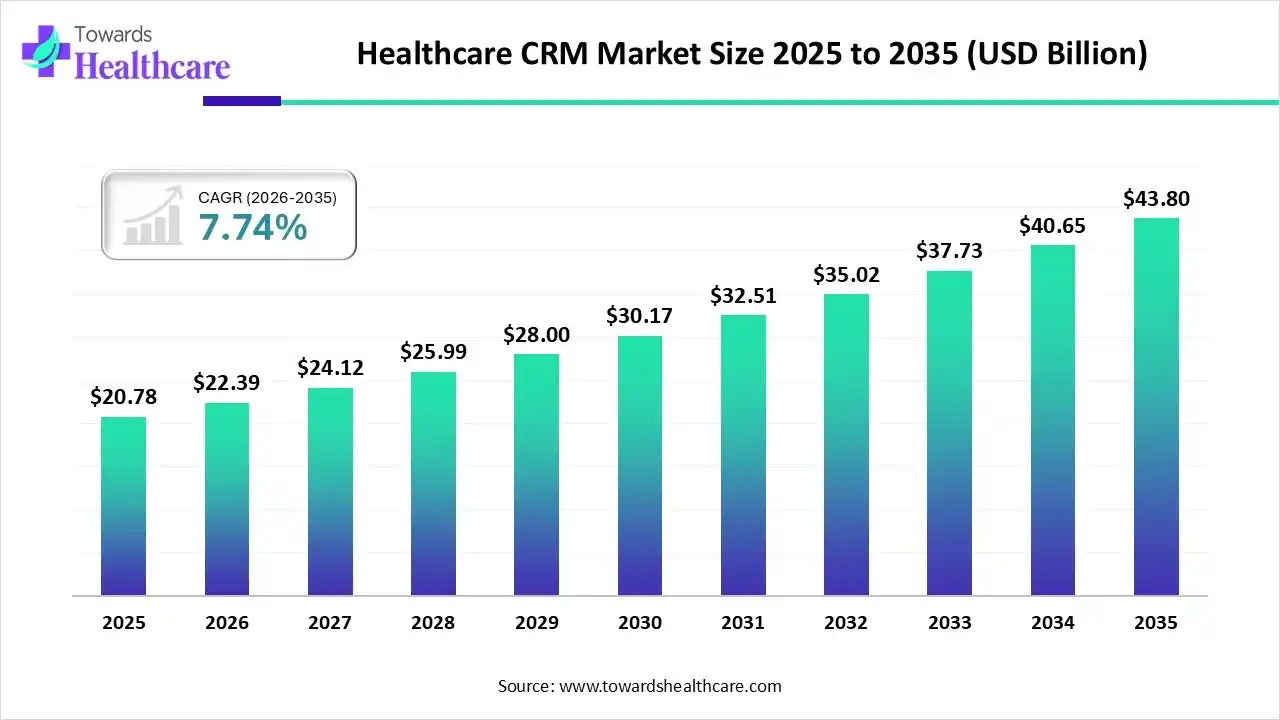
The opportunity is growing quickly. According to Towards Healthcare, the global healthcare CRM market was valued at USD 20.78 billion in 2025, reached USD 22.39 billion in 2026, and is projected to reach USD 43.8 billion by 2035, expanding at a 7.74% CAGR. North America held approximately 58% of the global market in 2025.
Request a Sample Report: https://www.towardshealthcare.com/download-sample/5422
Why Targeted Preventive-Care Outreach Matters
The need for better patient outreach is clear from U.S. government data.
The CDC reports that 90.3% of U.S. adults had a usual source of healthcare in 2024. Having a regular source of care is associated with a greater likelihood of receiving preventive screenings and services.
Yet having access to a provider does not automatically mean every recommended preventive service is completed.
For example, AHRQ’s nationally representative MEPS analysis found that among women aged 50–64, 72.6% received breast cancer screening and 61.2% received colorectal cancer screening in the 2015 dataset. Among men aged 50–64, colorectal cancer screening was 56.2%.
These gaps create a clear opportunity for targeted CRM campaigns.
Think of the workflow this way:
Patient data → Identify care gap → Segment patients → Personalized outreach → Appointment → Follow-up → Measure completion
That is much more useful than simply sending a generic “Schedule your appointment” email.
What Should a Healthcare CRM Do?
A strong preventive-care CRM should help healthcare organizations answer five basic questions:
Who needs care?
Identify patients who are due or overdue for recommended services.
What do they need?
Determine whether the gap relates to screening, vaccination, wellness visits, or another preventive service.
How should we reach them?
Select appropriate communication channels such as email, SMS, phone, or patient portals.
Did they respond?
Track appointments, engagement, and follow-up activity.
Did the care gap close?
Measure whether the patient ultimately received the recommended service.
This is where CRM moves beyond traditional contact management and becomes a patient-engagement and population-health tool.
Leading Healthcare CRM Platforms for Targeted Outreach
1. Salesforce Health Cloud
Salesforce Health Cloud is a strong option for larger healthcare organizations that need sophisticated patient segmentation, workflow automation, personalization, and integration.
It can support patient journeys where different populations receive different messages based on their healthcare needs.
For example:
Patients aged 50+ with no recorded colorectal cancer screening → targeted reminder → follow-up message → appointment tracking.
Its biggest advantage is flexibility for organizations with complex patient-engagement requirements.
2. Microsoft Dynamics 365
Microsoft Dynamics 365 can be attractive for healthcare organizations already using the Microsoft ecosystem.
Its CRM, analytics, automation, and data capabilities can support targeted engagement campaigns while allowing organizations to build workflows around different patient populations.
For preventive care, this can help providers move from mass communication to segmented outreach.
3. Oracle Health
Oracle Health is particularly relevant for large health systems that need CRM and patient engagement capabilities connected with broader healthcare technology infrastructure.
For organizations managing large patient populations, integration is important because preventive-care campaigns are only as effective as the data used to identify eligible patients.
4. HubSpot
HubSpot is not healthcare-specific, but its CRM and marketing automation capabilities can be useful for healthcare organizations with appropriate privacy, security, and compliance controls.
It can support:
- Email campaigns
- Patient segmentation
- Automated workflows
- Lead/contact management
- Campaign reporting
It may be more suitable for organizations looking for straightforward marketing automation rather than a highly specialized enterprise healthcare CRM.
5. Creatio
Creatio combines CRM with workflow automation and low-code customization.
This can be useful when healthcare organizations want to build specific outreach workflows without developing everything from scratch.
For example, a provider could create a workflow that identifies eligible patients, triggers a reminder, schedules follow-ups, and records campaign outcomes.
The Numbers Behind Healthcare CRM Adoption
Towards Healthcare’s latest research shows how quickly healthcare CRM is expanding.
Global Healthcare CRM
- 2025: USD 20.78 billion
- 2026: USD 22.39 billion
- 2035: USD 43.8 billion
- CAGR: 7.74%
- North America share in 2025: 58%
- Cloud/web-based deployment share in 2025: 60%
- Healthcare provider end-use share in 2025: 50%
Towards Healthcare also identifies patient engagement, appointment management, care coordination, marketing automation, and population-health outreach among the key applications of healthcare CRM.
This is especially relevant to preventive care because the technology is increasingly being used to connect patient data with actionable engagement.
Personalized Outreach Is Becoming the Center of CRM
Another interesting statistic comes from Towards Healthcare’s healthcare customer data platform research.
In 2025:
- Personalized patient engagement accounted for 30%
- Marketing and campaign management accounted for 22%
- Data management and interoperability accounted for 18%
- Population health management accounted for 15%
- Predictive analytics accounted for 15%
The 30% share for personalized patient engagement is particularly important.
It suggests that healthcare organizations are increasingly looking for technology that does more than collect patient information they want to use that information to create more relevant and timely interactions.
U.S. Healthcare CRM Is Also Expanding
Towards Healthcare estimates that the U.S. healthcare CRM market will grow from USD 9.92 million in 2024 to USD 19.94 million by 2034, representing a 7.23% CAGR.
The research identifies healthcare providers as the largest end-use segment, while healthcare payers are expected to experience the fastest growth.
This is significant because both sides of the healthcare ecosystem have an incentive to improve preventive engagement.
Providers want patients to complete screenings and appointments.
Payers want members to use appropriate preventive services and manage health risks earlier.
Where Government Data Meets CRM Technology
The government data makes the opportunity particularly clear.
The CDC reports that 76.2% of U.S. adults had a routine checkup in 2022, meaning roughly one in four adults did not report a routine checkup in the previous year.
Regular checkups can include preventive activities such as vaccinations, screenings, blood-pressure checks, weight assessment, and cholesterol testing.
This is exactly the type of population that targeted outreach can potentially reach.
A CRM can help a healthcare organization move from:
“We have thousands of patients.”
to:
“We have 2,000 patients due for preventive screening, 800 who haven’t responded to the first reminder, and 250 who have already scheduled.”
That shift from data to action is where CRM becomes valuable.
What Should Healthcare Buyers Look For?
When comparing CRM tools for preventive-care campaigns, healthcare organizations should focus on:
1. Patient segmentation
Can the system create meaningful patient groups based on age, care history, risk factors, and preventive-care eligibility?
2. EHR integration
Can the CRM work with the organization’s existing clinical systems?
3. Omnichannel outreach
Can teams communicate through email, SMS, phone, portals, and other approved channels?
4. Automation
Can follow-up messages be triggered automatically when patients do not respond?
5. Personalization
Can the system tailor communication to the patient’s specific care gap?
6. Analytics
Can healthcare leaders measure response rates, appointments, and completed preventive services?
7. Privacy and compliance
Can the platform support appropriate handling of protected health information and applicable healthcare regulations?
The Future: From Reminders to Intelligent Engagement
Healthcare CRM is evolving from a basic patient-contact database into a more intelligent engagement and care-coordination platform.
AI, predictive analytics, cloud platforms, interoperability, and automation are making it possible to identify patients who may need attention and deliver more personalized communications.
The goal isn’t simply to send more messages.
The goal is to send better messages to the right patients at the right moment.
For example:
Instead of:
“Your healthcare provider recommends preventive screening.”
A targeted campaign could say:
“You may be due for your recommended colorectal cancer screening. Schedule with your care team to discuss your options.”
That difference may seem small, but at population scale, better targeting can make outreach substantially more actionable.
Expert Perspective by Payal Rabde – uncovering key trends and opportunities across the healthcare industry.
Unlock deeper healthcare intelligence with our Ecosystem Dashboard : https://www.towardshealthcare.com/access-dashboard
About Us
Pharma Geek is a part of Towards Healthcare Research & Consulting which is a global healthcare market research and consulting firm dedicated to helping businesses make informed decisions through reliable market intelligence and strategic insights. We serve pharmaceutical, biotechnology, medical device, AI in healthcare, cell and gene therapy, digital health, and life sciences organizations with in-depth market research, custom consulting, competitive analysis, and growth forecasts. Our team combines industry expertise with rigorous research to deliver clear, actionable insights that support market expansion, product strategy, investment decisions, and long-term business growth. From emerging innovations to established healthcare markets, we help organizations understand where the industry is today and where it’s headed tomorrow.
You can place an order or ask any questions, please feel free to contact us at [email protected]
Europe Region – +44 778 256 0738
North America Region – +1 8044 4193 44
APAC Region: +91 9356 9282 04
Visit Our Website: Towards Healthcare Research & Consulting – Expert Consulting Solutions & Research Reports
Find us on social platforms: LinkedIn | Twitter | Instagram | Medium
