
 by
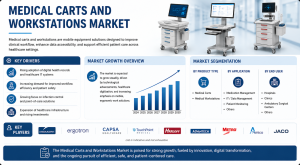
by The global medical carts and workstations market size is calculated at USD 5.15 billion in 2025 and is predicted to increase from USD 6.13 billion in 2026 to approximately USD 28.11 billion by 2035, expanding at a CAGR of 18.50% from 2026 to 2035.
What Are Medical Carts and Workstations?
Medical carts and workstations are mobile or stationary platforms specifically designed to support healthcare professionals in delivering safe, efficient, and organized patient care. These units combine storage, computing technology, power systems, and medical equipment into a single workstation that can easily move throughout hospitals, clinics, ambulatory surgical centers, and long-term care facilities.
Unlike traditional carts used solely for transporting medical supplies, modern workstations function as complete mobile healthcare centers. They enable physicians, nurses, pharmacists, and other healthcare professionals to access patient records, administer medications, review laboratory reports, document clinical information, and communicate with other departments without leaving the patient’s bedside.
Get Sample Link: https://www.precedenceresearch.com/sample/1920
The Evolution of Mobile Healthcare Technology
The healthcare industry has experienced remarkable technological advancements over the past few decades, transforming the way medical professionals deliver patient care. Traditionally, healthcare workers relied on paper records, stationary computers, and manual documentation, which often resulted in delayed access to patient information and increased administrative workloads. As hospitals expanded and patient volumes grew, there was a clear need for mobile solutions that could bring essential medical tools and digital information directly to the point of care.
How Digital Transformation Is Reshaping Healthcare Workflows
Digital transformation is fundamentally changing healthcare delivery by replacing traditional paper-based processes with connected, data-driven systems. Hospitals worldwide are investing in advanced healthcare technologies to improve patient safety, increase operational efficiency, and enhance collaboration among healthcare professionals. Medical carts and workstations play a central role in this transformation by providing clinicians with mobile access to digital tools and patient information wherever care is delivered.
The integration of electronic health records (EHRs) has eliminated the need for manual documentation and significantly reduced paperwork. Healthcare professionals can instantly access patient histories, laboratory reports, diagnostic images, medication records, and treatment plans using mobile workstations. This real-time access enables faster clinical decisions, minimizes documentation errors, and improves communication between multidisciplinary care teams.
Infection Prevention and Antimicrobial Workstation Design
Preventing healthcare-associated infections (HAIs) remains a major priority for hospitals worldwide. Medical carts frequently move between patient rooms, making infection prevention a critical design consideration.
Manufacturers now incorporate antimicrobial materials, seamless construction, and easy-to-clean surfaces into modern workstations.
Common infection-control features include:
- Antimicrobial coatings
- Non-porous surfaces
- Chemical-resistant materials
- Enclosed storage compartments
- Touch-free drawer systems
- Smooth, seamless construction
- Disposable keyboard covers
- Cable management systems
These features reduce contamination risks while supporting hospital infection-control protocols.
Battery Technology and Mobile Power Solutions
Reliable battery performance is essential for uninterrupted healthcare operations.
Modern medical carts increasingly utilize lithium-ion and lithium iron phosphate batteries, offering significantly longer operating times than traditional lead-acid batteries.
Recent innovations include:
- Hot-swappable battery systems
- Intelligent battery monitoring
- Fast charging technology
- Energy-efficient power management
- Lightweight battery designs
- Extended operating life
Some advanced mobile workstations now provide continuous operation throughout an entire nursing shift without requiring recharging, improving productivity and reducing workflow interruptions.
Impact of Internet of Things (IoT) and Connected Healthcare
The Internet of Things (IoT) is transforming the healthcare industry by connecting medical devices, hospital equipment, healthcare professionals, and patients through secure digital networks. In the medical carts and workstations market, IoT technology is enabling real-time communication, remote monitoring, predictive maintenance, and seamless data exchange, making healthcare delivery more efficient and patient-centric.
Modern medical carts are increasingly equipped with IoT-enabled sensors and wireless connectivity, allowing healthcare providers to access patient records, monitor medical equipment, and communicate with hospital information systems without delays. These connected workstations serve as mobile digital hubs that integrate Electronic Health Records (EHRs), medical imaging systems, laboratory reports, medication management platforms, and clinical decision-support tools into a single interface.
Read More: Biotechnology Instruments Market
Regional Analysis
North America
North America held the largest share of the global medical carts and workstations market in 2025 and is expected to maintain its leadership throughout the forecast period. The region’s dominance is supported by a well-established healthcare infrastructure, widespread adoption of electronic health records (EHRs), and strong investments in healthcare IT solutions. Hospitals and healthcare providers across the United States and Canada are rapidly adopting mobile workstations to enhance clinical workflows, improve patient safety, and reduce medication errors.
The growing prevalence of chronic diseases, an aging population, and increasing demand for efficient patient management systems are encouraging healthcare facilities to invest in technologically advanced medical carts. The expansion of telemedicine services, integration of artificial intelligence into healthcare, and strong presence of leading medical equipment manufacturers further strengthen the regional market. Additionally, favorable government initiatives promoting healthcare digitization and smart hospitals continue to accelerate market growth.
Europe
Europe represents a significant share of the global medical carts and workstations market, supported by well-developed public healthcare systems and increasing investments in healthcare modernization. Countries such as Germany, the United Kingdom, France, Italy, and the Netherlands are actively adopting digital healthcare technologies to improve clinical efficiency and patient outcomes.
The region is witnessing increasing deployment of mobile workstations across hospitals, outpatient clinics, and long-term care facilities. Government initiatives promoting digital patient records, combined with rising demand for point-of-care services, are driving equipment upgrades throughout healthcare facilities. Europe’s rapidly aging population is also increasing the need for efficient patient monitoring and medication management systems.
Asia-Pacific
Asia-Pacific is projected to register the fastest CAGR during the forecast period due to rapid healthcare infrastructure development and increasing healthcare expenditure. Emerging economies such as China, India, Indonesia, Vietnam, and Thailand are investing heavily in hospital construction, digital health initiatives, and healthcare accessibility.
The region’s large population, rising burden of chronic diseases, and increasing awareness of advanced healthcare technologies are creating substantial demand for medical carts and workstations. Governments across Asia-Pacific are implementing healthcare modernization programs that encourage hospitals to adopt electronic health records, telemedicine platforms, and mobile clinical workstations.
Latin America
Latin America is emerging as a promising market for medical carts and workstations, supported by improving healthcare infrastructure and increasing investments in digital healthcare. Countries including Brazil, Mexico, Argentina, Chile, and Colombia are modernizing hospitals and expanding access to quality healthcare services.
Healthcare providers are gradually replacing traditional equipment with mobile workstations that improve workflow efficiency and patient care. The region is also witnessing increasing adoption of electronic medical records and telehealth services, creating demand for integrated medical carts equipped with computing systems.
Middle East & Africa
The Middle East & Africa region is expected to experience steady growth, driven by significant investments in healthcare infrastructure, smart hospitals, and medical tourism. Countries such as Saudi Arabia, the United Arab Emirates, Qatar, and South Africa are investing heavily in advanced healthcare facilities as part of long-term economic diversification strategies.
Healthcare providers are increasingly adopting digital healthcare technologies, including electronic health records, mobile workstations, and connected medical devices, to improve operational efficiency and patient care. The expansion of specialized hospitals, rising prevalence of chronic diseases, and increasing demand for high-quality healthcare services are further contributing to market growth.
Future Outlook
The future of the medical carts and workstations market remains highly promising. Growing investments in digital healthcare, artificial intelligence, IoT, cloud computing, and smart hospitals will continue driving demand for intelligent mobile workstations.
Healthcare providers increasingly recognize that mobile clinical workstations improve productivity, reduce medical errors, enhance patient safety, and support better healthcare outcomes. As healthcare systems continue evolving toward connected and patient-centered care, medical carts will become even more sophisticated, integrating predictive analytics, autonomous navigation, remote diagnostics, and real-time clinical decision support.
𝐘𝐨𝐮 𝐜𝐚𝐧 𝐩𝐥𝐚𝐜𝐞 𝐚𝐧 𝐨𝐫𝐝𝐞𝐫 𝐨𝐫 𝐚𝐬𝐤 𝐚𝐧𝐲 𝐪𝐮𝐞𝐬𝐭𝐢𝐨𝐧𝐬, 𝐩𝐥𝐞𝐚𝐬𝐞 𝐟𝐞𝐞𝐥 𝐟𝐫𝐞𝐞 𝐭𝐨 𝐜𝐨𝐧𝐭𝐚𝐜𝐭 𝐮𝐬 𝐚𝐭 𝐬𝐚𝐥𝐞𝐬@𝐩𝐫𝐞𝐜𝐞𝐝𝐞𝐧𝐜𝐞𝐫𝐞𝐬𝐞𝐚𝐫𝐜𝐡.𝐜𝐨𝐦
