
 by
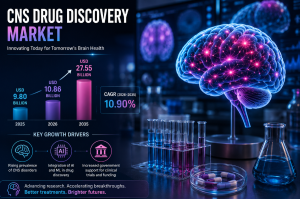
by The global CNS drug discovery market was valued at USD 9.80 billion in 2025 and is expected to witness robust growth over the next decade, driven by technological innovation, increased research investments, and growing demand for effective neurological treatments.
The burden of central nervous system (CNS) disorders continues to rise, creating an urgent need for innovative therapies and accelerated drug development. Conditions such as Alzheimer’s disease, Parkinson’s disease, epilepsy, multiple sclerosis, depression, schizophrenia, and other neurological disorders affect millions of people worldwide and place significant pressure on healthcare systems.
As pharmaceutical companies increasingly leverage artificial intelligence (AI), machine learning (ML), genomics, and advanced biomarker technologies, the CNS drug discovery landscape is undergoing a major transformation. These advancements are helping researchers improve target identification, optimize drug candidates, and reduce the traditionally high failure rates associated with neurological drug development.
CNS Drug Discovery Market Overview
CNS drug discovery refers to the process of identifying, developing, and evaluating therapeutic compounds designed to treat disorders affecting the brain, spinal cord, and nervous system. The market encompasses drug target identification, screening technologies, preclinical research, computational drug design, biomarker discovery, and clinical development support services.
Historically, CNS drug development has been one of the most challenging areas in the pharmaceutical industry due to the complexity of neurological diseases, the blood-brain barrier, and limited understanding of disease mechanisms. However, recent breakthroughs in neuroscience research and digital technologies are significantly improving success rates and accelerating drug discovery timelines.
Growing healthcare expenditures, increasing prevalence of neurodegenerative diseases, and rising government funding for neuroscience research continue to support market expansion globally.
CNS Drug Discovery Market Size and Forecast
| Year | Market Size (USD Billion) |
|---|---|
| 2025 | 9.80 |
| 2026 | 10.86 |
| 2030 | 16.41 |
| 2035 | 27.55 |
Market CAGR (2026–2035): 10.90%
The market is projected to nearly triple during the forecast period as pharmaceutical companies increase investments in neurological drug pipelines and adopt advanced technologies to improve research productivity.
Download the Sample: https://www.precedenceresearch.com/sample/8474
CNS Drug Discovery Market Growth Drivers
Rising Prevalence of Neurological Disorders
- Neurological diseases are becoming increasingly common due to aging populations, lifestyle changes, and growing awareness of mental health conditions. Alzheimer’s disease, Parkinson’s disease, dementia, epilepsy, and depression continue to represent major healthcare challenges worldwide.
- The growing patient population is creating substantial demand for innovative CNS therapeutics, encouraging pharmaceutical companies to expand their research activities.
Integration of Artificial Intelligence and Machine Learning
- AI and machine learning are transforming CNS drug discovery by enabling researchers to analyze complex biological datasets, identify novel therapeutic targets, and predict drug efficacy more accurately.
- These technologies reduce development timelines, lower research costs, and improve the probability of successful clinical outcomes. AI-driven platforms are becoming critical tools for pharmaceutical companies seeking to accelerate neurological drug development.
Increasing Government Funding and Clinical Trial Support
- Governments and healthcare organizations are investing heavily in neuroscience research and clinical development programs. Public funding initiatives focused on Alzheimer’s disease, mental health disorders, and rare neurological conditions are creating favorable conditions for market growth.
- Collaborative research programs between academic institutions, biotechnology firms, and pharmaceutical companies are further accelerating innovation.
Advancements in Precision Medicine
- Precision medicine approaches are helping researchers develop targeted therapies based on genetic, molecular, and biomarker profiles. These advancements are improving treatment effectiveness and enabling more personalized therapeutic strategies for CNS disorders.
- The growing adoption of precision medicine is expected to significantly influence future drug discovery efforts.
Key Trends Shaping the CNS Drug Discovery Market
AI-Powered Drug Discovery Platforms
- Artificial intelligence is rapidly becoming a cornerstone of modern CNS drug development. AI algorithms can identify promising drug candidates, optimize molecular structures, and predict potential safety concerns much faster than traditional methods.
- This trend is helping pharmaceutical companies improve efficiency while reducing research costs.
Growth of Neurodegenerative Disease Research
- Research efforts focused on Alzheimer’s disease, Parkinson’s disease, Huntington’s disease, and amyotrophic lateral sclerosis (ALS) continue to attract significant investments.
- As the global population ages, neurodegenerative disorders are expected to become one of the largest therapeutic areas within CNS drug discovery.
Expansion of Biomarker-Based Research
- Biomarkers are becoming increasingly important for disease diagnosis, patient stratification, and treatment monitoring.
- Advanced biomarker technologies are helping researchers better understand disease progression and improve clinical trial success rates.
Increased Adoption of Genomics and Multi-Omics Technologies
- Genomics, proteomics, metabolomics, and transcriptomics are providing deeper insights into the biological mechanisms underlying CNS disorders.
- These technologies are enabling researchers to identify novel therapeutic targets and accelerate precision medicine initiatives.
Rising Interest in Gene and Cell Therapies
- Gene therapies and cell-based treatments are emerging as promising approaches for addressing complex neurological disorders.
- Biotechnology companies are increasingly exploring advanced therapeutic modalities that have the potential to deliver long-term or curative benefits.
Competitive Landscape
The CNS drug discovery market is highly competitive and characterized by significant research investments, strategic collaborations, and technological innovation.
Major pharmaceutical companies, biotechnology firms, contract research organizations (CROs), and AI-driven drug discovery startups are actively competing to develop next-generation neurological therapies.
CNS Drug Discovery Market Companies
-
- Novartis
- Pfizer
- AbbVie
- Biogen
- Bristol Myers Squibb
- Johnson & Johnson Innovative Medicine
- Otsuka Pharmaceutical
- Takeda Pharmaceutical
- UCB
- Neurocrine Biosciences
- Acadia Pharmaceuticals
- Denali Therapeutics
- Alkermes
Research collaborations between pharmaceutical companies, academic institutions, and technology providers continue to drive innovation and accelerate drug development timelines.
Read More: Concierge Medicine Market
Segments Covered in the Report
By Drug Type
- Small Molecules
- Biologics
- Gene Therapies
- Cell Therapies
By Indication
- Alzheimer’s Disease
- Parkinson’s Disease
- Epilepsy
- Multiple Sclerosis
- Schizophrenia
- Depression and Anxiety Disorders
- Others
By Discovery Stage
- Target Identification and Validation
- Lead Identification
- Lead Optimization
- Preclinical Development
By Technology
- High Throughput Screening (HTS)
- Genomics and Proteomics
- AI-enabled Drug Discovery
- Biomarker-based Discovery
- CRISPR and Gene Editing Platforms
By End Use
- Pharmaceutical Companies
- Biotechnology Companies
- Academic and Research Institutes
- Contract Research Organizations (CROs)
By Region
- North America
- Latin America
- Europe
- Asia-pacific
- Middle and East Africa
Future Outlook
The future of the CNS drug discovery market appears exceptionally promising. As neurological disorders become more prevalent globally, the demand for effective and personalized treatments will continue to increase. Artificial intelligence, machine learning, advanced biomarkers, genomics, and precision medicine are expected to reshape the drug discovery landscape over the coming decade. These technologies will help overcome many of the traditional challenges associated with CNS drug development, improving both efficiency and success rates.
Additionally, growing investments in neuroscience research, expanding clinical trial activities, and supportive government initiatives will create substantial opportunities for industry participants. By 2035, the CNS drug discovery market is expected to reach approximately USD 27.55 billion, reflecting the critical role of innovation and advanced research technologies in addressing some of the world’s most complex neurological diseases.
As the industry continues to evolve, organizations that invest in AI-driven discovery platforms, precision medicine capabilities, and collaborative research ecosystems are likely to emerge as leaders in the next generation of CNS therapeutics.
𝐘𝐨𝐮 𝐜𝐚𝐧 𝐩𝐥𝐚𝐜𝐞 𝐚𝐧 𝐨𝐫𝐝𝐞𝐫 𝐨𝐫 𝐚𝐬𝐤 𝐚𝐧𝐲 𝐪𝐮𝐞𝐬𝐭𝐢𝐨𝐧𝐬, 𝐩𝐥𝐞𝐚𝐬𝐞 𝐟𝐞𝐞𝐥 𝐟𝐫𝐞𝐞 𝐭𝐨 𝐜𝐨𝐧𝐭𝐚𝐜𝐭 𝐮𝐬 𝐚𝐭 𝐬𝐚𝐥𝐞𝐬@𝐩𝐫𝐞𝐜𝐞𝐝𝐞𝐧𝐜𝐞𝐫𝐞𝐬𝐞𝐚𝐫𝐜𝐡.𝐜𝐨𝐦
