
Uncategorized

US Cardiovascular Drugs Market Size to Reach USD 37.03 Billion by 2035

US Cardiovascular Drugs Market Size and Forecast 2026 to 2035

The US cardiovascular drugs market size accounted for USD 28.42 billion in 2025 and is predicted to increase from USD 29.25 billion in 2026 to approximately USD 37.03 billion by 2035, expanding at a CAGR of 2.68% from 2026 to 2035.
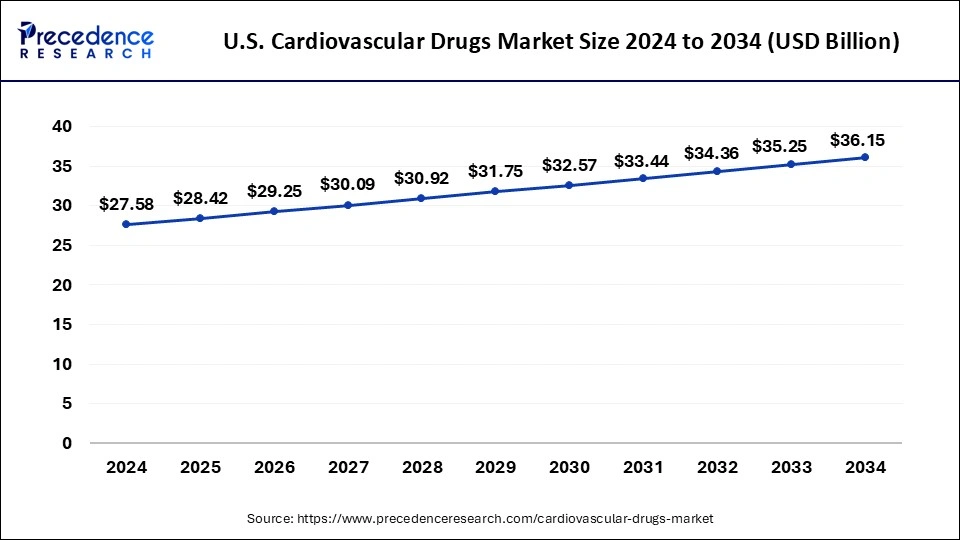
US Cardiovascular Drugs Market Size 2025 to 2035

US Cardiovascular Drugs Market Key Takeaways

  • By drug type, the anticoagulants segment held a major market share in 2025.
  • By drug type, the antihypertensive segment is expected to expand at the fastest CAGR from 2026 to 2035.
  • By disease indication, the hypertension segment contributed the highest market share in 2025.
  • By disease indication, the arrhythmias segment is growing at a strong CAGR between 2026 and 2035.
  • By route of administration, the oral segment generated the biggest market share in 2025.
  • By route of administration, the parenteral segment is expanding at the fastest CAGR between 2026 and 2035.
  • By distribution channel, the retail stores segment accounted for the largest market share in 2025.

US Cardiovascular Drugs Market Overview

The U.S. cardiovascular drugs market encompasses a wide range of pharmaceutical therapies used for the treatment and management of cardiovascular and vascular diseases. These medications are designed to support heart function, regulate blood circulation, control risk factors, and reduce the likelihood of severe cardiovascular events, thereby improving patient outcomes and survival rates. Market growth is primarily driven by the rising prevalence of cardiovascular conditions such as hypertension and hyperlipidemia, an expanding aging population, and increasing investments in clinical research, drug development, and innovative product launches.

How is AI Transforming the US Cardiovascular Drugs Market Industry?

Artificial intelligence (AI) is transforming the U.S. cardiovascular drugs market by streamlining drug discovery, improving clinical trial efficiency, and enabling personalized treatment approaches. AI-powered technologies help identify promising drug candidates, optimize trial designs, enhance patient recruitment, and predict treatment responses, significantly reducing the time and cost associated with cardiovascular drug development. Additionally, AI-driven analysis of electrocardiograms (ECGs), medical imaging, and patient data can detect conditions such as heart failure and arrhythmias at earlier stages, allowing healthcare providers to identify patients who are most likely to benefit from targeted cardiovascular therapies. This advancement is supporting more precise treatment decisions and improved patient outcomes.

US Cardiovascular Drugs Market: Country-Level Analysis

  • GLP-1s Target Heart Failure in California and Texas: Beyond standard beta-blockers and anticoagulants, pharmaceutical companies are exploring broader applications of GLP-1 agonists, such as tirzepatide, targeting non-diabetic heart failure patients in heavily populated areas like California and Texas.
  • CVD Surges and Medication Demands in the Southern U.S.: With heart disease as the leading cause of death nationally, the Southern U.S. faces a significant disease burden. States like Mississippi, Alabama, and Oklahoma have high rates of cardiovascular mortality, driving a continuous demand for antihypertensive and cholesterol-lowering medications.
  • Massachusetts and New Jersey Billion-Dollar Biotech Alliances: Major medical companies and biotechnology innovators are collaborating to produce next-generation heart therapies. Research parks in Massachusetts, particularly in the Cambridge area, and New Jersey, are at the forefront of these high-quality clinical trial investments.
  • Expanding Hospital Networks across Florida and Arizona: To combat chronic heart conditions, large hospital chains are expanding their regional networks. States like Florida and Arizona are experiencing rapid healthcare infrastructure growth to accommodate their influx of elderly residents.
  • New York and Illinois Lead the Charge in Preventive Care: Organizations like the American Heart Association have launched campaigns emphasizing that cardiovascular diseases are preventable. Local healthcare funding in states like New York and Illinois focuses on early education and preventive drug therapy.
  • Navigating FDA Trials from Pennsylvania to Minnesota: The U.S. Food and Drug Administration (FDA) continuously monitors drug efficacy and safety in the cardiovascular market. Companies frequently conduct clinical trials in major medical centers located in Pennsylvania and Minnesota to support new commercial drug rollouts.

US Cardiovascular Drugs Market Segmentation Analysis

US Cardiovascular Drugs Drug Market Type Insights

The anticoagulants segment held the largest share of the U.S. cardiovascular drugs market in 2025. This dominance can be attributed to their strong safety profile, high efficacy, and improved patient compliance compared to traditional treatment options, particularly for the prevention of stroke and thromboembolic events. The growing prevalence of cardiovascular diseases, atrial fibrillation, and myocardial infarction among the aging population has significantly increased the demand for anticoagulant therapies. Furthermore, their expanding use in preventive care, post-surgical management, and long-term treatment regimens continues to support sustained prescription volumes and market growth.

US Cardiovascular Drugs Disease Market Indication Insights

The hypertension segment dominated the U.S. cardiovascular drugs market in 2025, driven by a large patient population, increasing adoption of routine blood pressure screening, and the growing prevalence of sedentary lifestyles. As one of the leading risk factors for cardiovascular disease and premature mortality, hypertension continues to generate strong demand for antihypertensive medications. The market is also witnessing a shift toward fixed-dose combination therapies, which improve treatment adherence and help manage resistant hypertension more effectively. Additionally, rising obesity rates, unhealthy dietary patterns, and an expanding elderly population in the United States are expected to sustain long-term demand for hypertension-related treatments.

US Cardiovascular Drugs Market Scope

Report Coverage Details
Market Size in 2025 USD 28.42 Billion
Market Size in 2026 USD 29.25 Billion
Market Size by 2035 USD 37.03 Billion
Growth Rate from 2026 to 2035 CAGR of 2.68%
Base Year 2025
Forecast Period 2026 to 2035