 by
by What is the Lung Cancer Surgery Market Size?
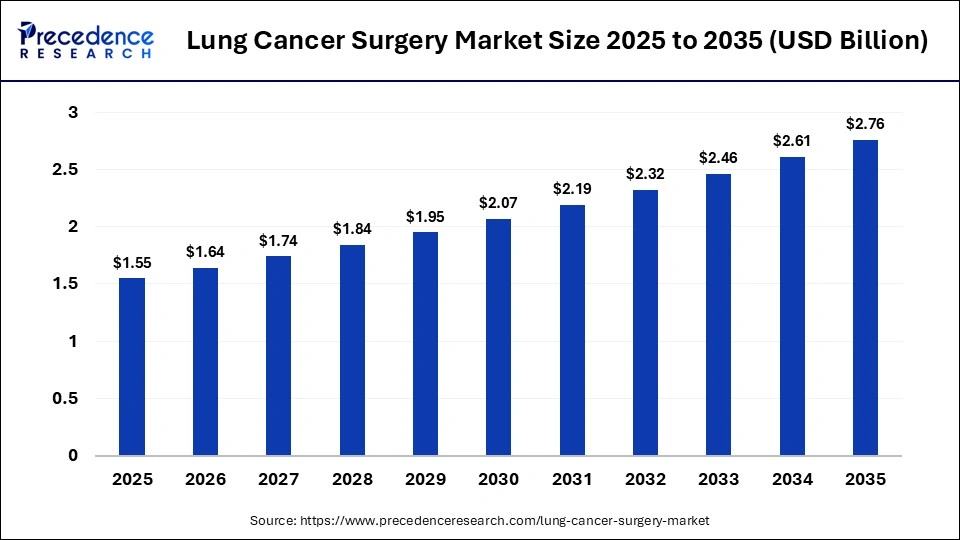
The global lung cancer surgery market was calculated at USD 1.55 billion in 2025 and is estimated to grow from USD 1.64 billion in 2026 to nearly USD 2.76 billion by 2035, registering a CAGR of 5.95% during the forecast period from 2026 to 2035.
Key Takeaways
- By region, North America led the lung cancer surgery market in 2025.
- By region, Asia Pacific is expected to grow at the fastest CAGR in the upcoming period.
- By procedure type, the lobectomy segment led the market with the largest share in 2025.
- By procedure type, the segmentectomy segment is observed to grow at the fastest CGAR during the foreseeable period.
- By surgical approach, the open surgery segment led the global market with a major share in 2025.
- By surgical approach, the video-assisted thoracoscopic surgery segment is expected to grow at the fastest rate in the foreseen period.
- By cancer type, the non-small cell lung cancer segment held the largest share of the market in 2025.
- By cancer type, the small cell lung cancer segment is observed to expand at the fastest rate in the coming years.
- By provider type, the hospitals segment led the market while holding the largest share of 65% in 2025.
- By provider type, the cancer care centers segment is observed to grow at the fastest rate in the foreseen period.
What are the Key Trends Influencing the Lung Cancer Surgery Market?
- Rising adoption of minimally invasive surgeries, including robot assisted and video assisted techniques, is reducing health risks, shortening recovery times, and minimizing hospital stays, thereby driving strong procedural demand.
- Growing government support for healthcare research, a strong regulatory framework, and increasing integration of AI technologies are strengthening innovation and driving sustained growth in the market.
- Increasing awareness of lung cancer and government initiatives supporting early detection are boosting timely surgical intervention, improving the surgery rate, and accelerating market growth.
- Advances in genomic sequencing may allow surgeons to identify genetic aberrations within a patient’s tumor and perform more advanced surgery followed by appropriate treatment.
Market Overview
Lung cancer remains the leading cause of cancer-related deaths globally, accounting for the highest mortality rates among both men and women. The increasing prevalence of tobacco smoking has significantly contributed to the rising incidence of lung cancer, resulting in more than 1.8 million deaths each year. Growing awareness regarding early diagnosis and timely treatment, especially as the disease is frequently detected at advanced stages with limited treatment options, is expected to drive the growth of the lung cancer surgery market. However, the high cost associated with lung cancer surgical procedures continues to act as a major challenge for market expansion.
Market Scope
| Report Coverage | Details |
| Market Size in 2025 | USD 1.55 Billion |
| Market Size in 2026 | USD 1.64 Billion |
| Market Size by 2035 | USD 2.76 Billion |
| Market Growth Rate from 2026 to 2035 | CAGR of 5.95% |
| Dominating Region | Asia Pacific |
| Fastest Growing Region | North America |
| Base Year | 2025 |
| Forecast Period | 2026 to 2035 |
| Segments Covered | Procedure Type, Surgical Approach Type, Cancer Type ,Provider Type , and Region |
| Regions Covered | North America, Europe, Asia-Pacific, Latin America, and Middle East & Africa |
Regional Insights
What Made North America the Leading Region in the Lung Cancer Surgery Market?
North America dominated the lung cancer surgery market, holding the largest share in 2025. This leadership is driven by advanced healthcare infrastructure and a high rate of technology adoption. The region’s strong position is further supported by the high prevalence of lung cancer cases, largely associated with smoking and environmental exposure, which directly increases the demand for surgical interventions. Additionally, favorable reimbursement policies and the widespread adoption of minimally invasive and robotic-assisted surgical technologies are accelerating procedure volumes. The presence of sophisticated systems such as the da Vinci Surgical System enhances surgical precision and clinical outcomes, further strengthening North America’s role in the global market.
U.S. Market Analysis
The U.S. lung cancer surgery market is driven by favorable regulatory environments and the pace of technological adoption. The market is experiencing steady expansion, supported by the increasing use of minimally invasive procedures such as VATS and robotic-assisted surgeries, which offer significant growth opportunities. In addition, early detection initiatives, particularly low-dose CT screening programs, are improving the diagnosis of operable tumors at earlier stages, further reinforcing market growth.
Segment Insights
Procedure Type Insights
How Does the Lobectomy Segment Dominate the Market?
The lobectomy segment accounted for the largest share of the lung cancer surgery market in 2025 and is expected to maintain its dominant position throughout the forecast period. The growth of this segment is primarily driven by its status as the standard surgical treatment for early-stage non-small cell lung cancer (NSCLC). First performed in 1913, lobectomy involves the surgical removal of a lobe of the lung and continues to be regarded as the gold-standard procedure for resectable lung cancer, particularly when combined with lymph node dissection.
Provider Type Insights
How Does the Hospitals Segment Lead the Market in 2025?
The hospitals segment dominated the lung cancer surgery market in 2025, accounting for the largest market share due to the availability of comprehensive healthcare infrastructure and advanced surgical technologies. Hospitals provide a broad range of treatment options, including chemotherapy, hormone therapy, and radiotherapy, supported by multidisciplinary medical teams and specialized surgical expertise. These advanced treatment capabilities make hospitals the preferred choice for lung cancer patients. Furthermore, rising patient awareness and improving insurance coverage are expected to further boost the demand for hospital-based lung cancer surgeries.
Operating in the Market Companies
- Accuray Incorporated specializes in advanced radiation therapy solutions for cancer treatment. The company is known for its CyberKnife and TomoTherapy systems that support precise and non-invasive tumor treatments.
- Teleflex Incorporated develops medical devices used in critical care, surgical, and interventional procedures. Its product portfolio supports minimally invasive surgeries and respiratory care solutions worldwide.
- B. Braun Melsungen AG provides healthcare products and surgical instruments for hospitals and clinics globally. The company focuses on patient safety, infusion therapy, and advanced surgical technologies.
- AngioDynamics Inc. manufactures minimally invasive medical devices for oncology, vascular access, and surgery. Its technologies are widely used in tumor ablation and image-guided therapeutic procedures.
- Richard Wolf GmbH is recognized for its innovative endoscopy and minimally invasive surgical systems. The company supplies advanced visualization and surgical equipment for various medical specialties.
- Stryker Corporation offers a wide range of surgical equipment, navigation systems, and medical devices. The company is a major provider of solutions for minimally invasive and robotic-assisted surgeries.
- KLS Martin Group develops surgical instruments, implant systems, and operating room technologies. Its products support precision surgery across thoracic, maxillofacial, and general surgical procedures.
- Boston Scientific Corporation provides innovative devices used in interventional pulmonology, oncology, and minimally invasive surgery. The company focuses on improving patient outcomes through advanced medical technologies.
- GE HealthCare delivers medical imaging, diagnostic, and digital healthcare solutions globally. Its advanced imaging systems play a crucial role in the early detection and surgical planning of lung cancer cases.
Recent Developments
- In February 2026, the European Society of Radiology (ESR) and the European Respiratory Society (ERS) introduced the European Lung Cancer Screening Alliance (ELCSA) at the European Cancer Screening and Early Detection Policy Summit in Brussels. According to ESR and ERS, ELCSA will unite clinical societies, researchers, patient advocates, and policymakers with the shared objective of enhancing early lung cancer detection.
- In 2025, Winship Cancer Institute of Emory University is strengthening its commitment to reducing lung cancer mortality across Georgia with the launch of the Emory Healthcare Lung Screening and Nodule Program. The program is dedicated to early detection and timely treatment of lung cancer by using low-dose CT lung screening and AI-assisted identification of incidentally detected pulmonary nodules.
Check this report to: ICU ECG Patient Market
Get this report to explore global market size, share, CAGR, and trends, featuring detailed segmental analysis and an insightful competitive landscape overview: https://www.precedenceresearch.com/sample/7863
You can place an order or ask any questions. Please feel free to contact us at [email protected] |+1 804 441 9344
