 by
by Nuclear Medicine Equipment Market Size in 2026
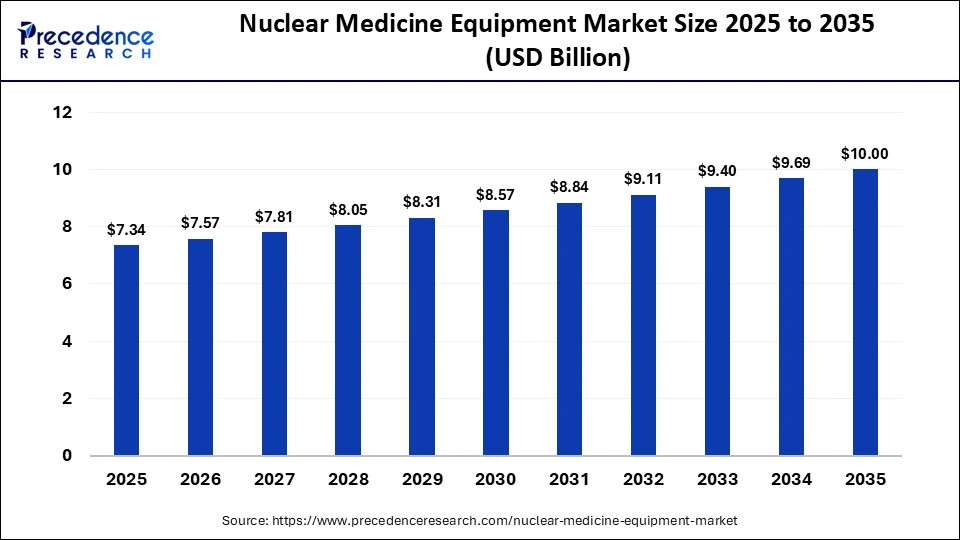
The global nuclear medicine equipment market is estimated to reach USD 7.57 billion in 2026, up from USD 7.34 billion in 2025. The market is projected to grow steadily to approximately USD 10.00 billion by 2035, expanding at a CAGR of 3.14% from 2026 to 2035.
Read Also: Preoperative Skin Preparation Market
Market Overview
The nuclear medicine equipment market represents a critical segment of advanced diagnostic imaging, utilizing radioactive tracers to evaluate organ function, metabolic activity, and disease progression. Unlike conventional imaging, nuclear medicine focuses on functional imaging, enabling early detection of diseases even before structural changes occur.
Key technologies include:
- SPECT (Single Photon Emission Computed Tomography)
- PET (Positron Emission Tomography)
- Hybrid systems (PET/CT, SPECT/CT)
- Gamma cameras and planar scintigraphy
These systems are widely used in:
- Oncology (cancer detection and monitoring)
- Cardiology (heart perfusion and function analysis)
- Neurology (brain disorders and cognitive diseases)
The market is gaining traction due to the increasing need for precise, early-stage diagnosis and the growing shift toward personalized and targeted therapies.
Key Growth Drivers
1. Rising Burden of Chronic Diseases
The increasing prevalence of:
- Cancer
- Cardiovascular diseases
- Neurological disorders
is significantly boosting demand for nuclear imaging technologies that allow early diagnosis and accurate disease staging.
2. Growing Demand for Minimally Invasive Diagnostics
Patients and healthcare providers are shifting toward non-invasive and low-risk diagnostic procedures, where nuclear imaging plays a vital role by:
- Reducing need for exploratory surgeries
- Improving diagnostic accuracy
- Supporting real-time monitoring
3. Expansion of Healthcare Infrastructure
Emerging economies such as India, China, and Southeast Asia are investing heavily in:
- Advanced diagnostic centers
- Hospital modernization
- Medical imaging technologies
This is expanding the installed base of nuclear medicine equipment globally.
Impact of Artificial Intelligence (AI)
Artificial intelligence is transforming nuclear medicine by enhancing both clinical efficiency and diagnostic precision:
- Automated image reconstruction improves scan clarity
- AI-based lesion detection enables early identification of abnormalities
- Workflow automation reduces clinician workload
- Predictive analytics supports personalized treatment planning
AI integration is particularly valuable in handling complex PET and SPECT datasets, reducing interpretation time and improving patient outcomes.
Key Market Trends
Adoption of Hybrid Imaging Systems
Hybrid systems like PET/CT and SPECT/CT are rapidly gaining popularity because they combine:
- Functional imaging (metabolic activity)
- Anatomical imaging (structural detail)
This results in higher diagnostic accuracy and better clinical decision-making.
Growth of Personalized Medicine
Nuclear imaging plays a key role in:
- Selecting targeted therapies
- Monitoring treatment response
- Enabling precision medicine approaches
Advancements in Detector Technologies
New-generation detectors such as CZT (Cadmium Zinc Telluride) offer:
- Higher sensitivity
- Better resolution
- Lower radiation exposure
Expansion of Radiopharmaceuticals
The development of new tracers is expanding applications across:
- Oncology
- Neurology
- Cardiology
This is directly increasing demand for advanced imaging systems.
Segment Insights (Expanded)
By Product Type
- SPECT systems dominated (58% share in 2025) due to cost-effectiveness and wide availability
- Hybrid PET/SPECT/CT systems are the fastest-growing due to superior diagnostic capabilities
By Application
- Oncology leads (50% share) due to rising cancer cases and need for early detection
- Neurology is fastest-growing, driven by increasing cases of:
- Alzheimer’s disease
- Parkinson’s disease
- Epilepsy
By End User
- Hospitals dominate (60% share) due to:
- Advanced infrastructure
- High patient volume
- Availability of skilled professionals
- Imaging centers are growing fastest due to:
- Cost efficiency
- Faster diagnostic services
- Outpatient convenience
By Detector Technology
- NaI (Sodium Iodide) dominates due to affordability and established use
- Solid-state/CZT detectors are growing fastest due to superior performance
Regional Insights
North America (Market Leader)
- Held 43% market share in 2025
- Driven by:
- Advanced healthcare infrastructure
- High adoption of cutting-edge imaging systems
- Strong reimbursement policies
Asia Pacific (Fastest Growing)
- Expected CAGR: ~5.0%
- Growth driven by:
- Expanding healthcare access
- Rising awareness of early diagnosis
- Government investments in healthcare
India Market Outlook
India is emerging as a key growth hub due to:
- Expanding hospital networks
- Rising medical tourism
- Government initiatives in nuclear medicine
- Increasing demand for advanced diagnostic imaging
Value Chain Analysis (Simplified)
- R&D & Innovation
- Focus on AI-integrated imaging and hybrid systems
- Component Manufacturing
- Detectors, radiopharmaceuticals, and electronics
- Equipment Manufacturing
- PET, SPECT, and hybrid system assembly
- Distribution & Installation
- Hospitals and imaging centers
- After-Sales Services
- Maintenance, training, and workflow optimization
Key Companies in the Market
Leading players driving innovation include:
- GE HealthCare
- Siemens Healthineers
- Philips Healthcare
- Canon Medical Systems
- United Imaging Healthcare
- Digirad Corporation
- Mediso Ltd.
These companies focus on:
- AI integration
- Hybrid imaging systems
- Advanced detector technologies
Future Outlook
The nuclear medicine equipment market is expected to witness steady but sustained growth driven by:
- Increasing cancer burden globally
- Rising adoption of hybrid imaging systems
- Expansion of radiopharmaceutical applications
- Growth in emerging markets
- Integration of AI and precision diagnostics
Despite a moderate CAGR, the market remains high-value and innovation-driven, with strong long-term demand due to its critical role in early diagnosis and personalized healthcare.
Get Sample Link: https://www.precedenceresearch.com/sample/7996
📩 For inquiries regarding discounts, bulk purchases, or customization requests, please contact us at [email protected]
