
 by
by The global AI in telemedicine market size is estimated at USD 26.11 billion in 2025 and is predicted to increase from USD 32.30 billion in 2026 to approximately USD 176.94 billion by 2034, expanding at a strong CAGR of 23.69% from 2025 to 2034.
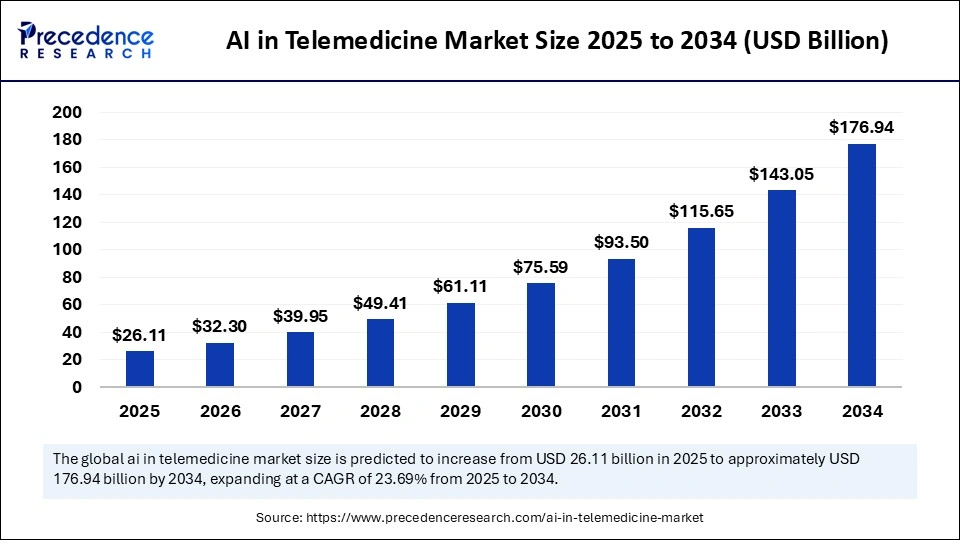
This expansion is fueled by increasing telehealth adoption, AI technology advancements, and growing demand for efficient remote healthcare solutions globally.
Get this report to explore global market size, share, CAGR, and trends, featuring detailed segmental analysis and an insightful competitive landscape overview @ https://www.precedenceresearch.com/sample/7053
Introduction: What’s Driving the Surge in AI-Powered Telemedicine?
The AI in the telemedicine market is revolutionizing healthcare delivery by integrating modern AI capabilities such as machine learning, natural language processing, and predictive analytics into telehealth platforms. These technologies enhance diagnostic accuracy, enable proactive patient monitoring, and streamline clinical workflows. Key market drivers include rising demand for virtual consultations, digital health innovation, and the pressing need to improve healthcare access in underserved and remote regions. Amid escalating global healthcare challenges, AI-driven telemedicine is positioning itself as a critical enabler of scalable, precise, and patient-centric care.
AI in Telemedicine Market Key Insights
-
The market was valued at USD 26.11 billion in 2025 and is predicted to reach USD 176.94 billion by 2034.
-
North America led the market with a 52.3% share in 2024, while the Asia Pacific is the fastest-growing region at a CAGR of 24.3%.
-
Software components commanded the largest share (43.4%) in 2024, with services poised to grow fastest (CAGR 23.0%).
-
Machine learning dominated the technology segment with 37.9% market share; natural language processing is the fastest-growing technology (CAGR 22.6%).
-
Remote patient monitoring accounted for 31.4% market share by application, while virtual consultation is expanding rapidly (CAGR 23.2%).
-
Hospitals and clinics represented the biggest end-user segment with 37.2%.
-
On-premise deployment led with 66.5% share, yet cloud-based solutions exhibit significant growth potential (CAGR 23.5%).
How AI Powers Telemedicine: A Transformative Role
AI’s role in telemedicine extends beyond automation to becoming the operational core of virtual healthcare ecosystems. Advanced machine learning algorithms enable real-time patient data analysis, predictive diagnostics, and personalization of treatment plans during remote consultations.
Natural language processing facilitates empathetic, multilingual patient interactions, essential for global accessibility. Additionally, AI-driven federated learning enhances data privacy while allowing models to learn from diverse populations, driving equitable and efficient care delivery worldwide.
Market Growth Factors: What’s Fueling This Surge?
Several factors propel the AI in telemedicine market’s rapid growth. These include the increasing prevalence of chronic diseases requiring continuous monitoring, heightened patient preference for convenient virtual care, and healthcare systems’ pursuit of cost efficiencies through digital transformation.
Technological advancements like the integration of wearable devices and IoT with AI support continuous remote monitoring, improving early intervention and reducing hospital readmissions. Regulatory support, expanding internet infrastructure, and rising investments by global tech and venture capital firms further accelerate adoption.
Market Scope
| Report Coverage | Details |
| Market Size in 2025 | USD 26.11 Billion |
| Market Size in 2026 | USD 32.30 Billion |
| Market Size by 2034 | USD 176.94 Billion |
| Market Growth Rate from 2025 to 2034 | CAGR of 23.69% |
| Dominating Region | North America |
| Fastest Growing Region | Asia Pacific |
| Base Year | 2024 |
| Forecast Period | 2025 to 2034 |
| Segments Covered | Component, Telchnology, Application, End User, Deployment Mode, and Region |
| Regions Covered | North America, Europe, Asia-Pacific, Latin America, and Middle East & Africa |
What Opportunities and Trends Are Reshaping AI in Telemedicine?
How are startups innovating in AI telehealth ecosystems?
Startups worldwide are developing niche AI applications targeting dermatology, mental health, and chronic disease management, pushing boundaries in accessible, affordable virtual care.
Can AI-enabled remote monitoring improve chronic disease outcomes?
AI algorithms analyzing continuous patient data facilitate proactive interventions, reducing complications and healthcare costs.
What sustainability benefits does AI telemedicine offer?
It lowers carbon emissions by minimizing patient travel and supports digital health equity, particularly in underserved regions.
How is AI enhancing teleconsultation experiences?
AI-driven virtual assistants and emotion recognition tools boost empathy and precision, transforming teleconsultations from transactional to highly personalized interactions.
Regional and Segment Analysis
North America dominates the market owing to its advanced digital infrastructure, robust investment landscape, and strong regulatory frameworks supporting telehealth innovation. The U.S. leads with AI-powered platforms like Teladoc and Amwell, driving virtual care adoption.
Asia Pacific shows the fastest growth, fueled by rising healthcare digitization in India, China, and Southeast Asia, alongside government initiatives promoting e-health accessibility.
By component, software remains the market backbone, enabling interoperability, predictive analytics, and real-time AI updates. Services grow rapidly as healthcare organizations demand AI system integration, customization, and training for seamless adoption.
Machine learning holds the largest technology share, driving diagnostic precision and adaptability. Remote patient monitoring leads applications due to its role in chronic care management.
Hospitals and clinics dominate end-user adoption because of greater resource availability and clinical needs.
The on-premise deployment retains primacy for data security and compliance, though cloud solutions expand accessibility and scalability.
Top AI in Telemedicine Market Companies
- IBM Corporation: IBM is a global pioneer in applying artificial intelligence to telemedicine through its Watson Health platform, which integrates advanced analytics, natural language processing, and machine learning to support clinical decision-making. Its AI solutions enable physicians to analyze vast medical datasets for faster, more accurate diagnoses during virtual consultations. IBM also focuses on remote patient monitoring, predictive health insights, and population health management, helping healthcare systems optimize care delivery and reduce costs. The company’s recent shift toward cloud-based AI tools strengthens interoperability and scalability across telehealth networks worldwide.
- Microsoft Corporation: Microsoft is a leader in AI-powered healthcare transformation, driven by its Azure Health Data Services and Cloud for Healthcare platforms. These tools enable a secure, HIPAA-compliant telemedicine infrastructure with embedded AI for real-time data analysis and care coordination. Microsoft’s AI solutions enhance virtual consultations through speech recognition, clinical documentation automation, and personalized treatment recommendations. By integrating Teams for Healthcare and Nuance’s conversational AI, Microsoft bridges communication between patients and providers, advancing the future of connected, intelligent telemedicine ecosystems.
- Google LLC: Google, through Google Health and DeepMind, plays a central role in advancing AI for telemedicine and digital health. Its machine learning models support medical imaging interpretation, disease prediction, and triage decision-making. At the same time, its Google Cloud Healthcare API facilitates secure data exchange between telehealth providers and electronic health records (EHRs). Google’s AI capabilities enhance symptom checking, virtual triage, and clinical research analytics, enabling healthcare organizations to deliver faster, more precise remote care. Its deep expertise in big data and natural language understanding positions it as a cornerstone of next-generation telehealth innovation.
- Intel Corporation: Intel underpins the telemedicine ecosystem with AI-driven computing, edge processing, and data analytics technologies. Its processors and AI accelerators enable real-time diagnostic imaging, patient monitoring, and secure data transmission across connected medical devices. Through collaborations with healthcare providers and software developers, Intel empowers scalable, high-performance telehealth platforms that deliver reliable virtual care experiences. The company’s focus on AI-enabled edge devices supports faster clinical insights and continuous health monitoring, particularly for rural and resource-limited healthcare environments.
- Philips Healthcare: Philips is a global leader in integrating AI into telemedicine through its HealthSuite digital platform, which connects patients and clinicians via secure, data-driven virtual care systems. Its AI algorithms enable predictive analytics, remote diagnostics, and chronic disease management with real-time data visualization. Philips’ solutions help healthcare providers personalize treatments, monitor patient progress remotely, and improve outcomes in cardiology, oncology, and critical care. By combining AI, cloud computing, and connected devices, Philips strengthens the future of proactive and patient-centered virtual healthcare.
Other Companies in the Market
- Siemens Healthineers: Siemens Healthineers applies AI and machine learning in telemedicine for diagnostic imaging, remote consultations, and clinical decision support. Its AI-Rad Companion and digital platforms automate image interpretation and enhance efficiency across virtual diagnostic workflows.
- GE Healthcare: GE Healthcare’s Edison platform integrates AI analytics into telemedicine to improve diagnostic accuracy, workflow automation, and virtual collaboration between clinicians. Its solutions bridge imaging, cardiology, and patient monitoring data for seamless remote care delivery.
- Nuance Communications, Inc.: Nuance, a Microsoft company, specializes in AI-driven conversational and voice recognition technology for telemedicine. Its Dragon Medical One platform enables automated clinical documentation, improving accuracy and efficiency during virtual consultations.
- Cerner Corporation: Cerner incorporates AI into its electronic health records and telemedicine systems to enable predictive analytics and patient monitoring. Its solutions enhance chronic disease management and remote care coordination for healthcare organizations.
- Teladoc Health, Inc.: Teladoc Health is a global leader in telemedicine, using AI-powered tools for triage, symptom analysis, and clinical decision support. Its predictive analytics optimize virtual consultation outcomes and personalize patient care pathways.
- Babylon Health: Babylon Health leverages AI chatbots and diagnostic algorithms to provide automated symptom checking and virtual triage. Its technology enables rapid, accessible teleconsultations and supports preventive healthcare through continuous learning systems.
- American Well (Amwell): Amwell integrates AI into telehealth operations for intelligent patient triage, appointment scheduling, and clinician matching. Its analytics-driven platform enhances patient engagement and improves the efficiency of virtual healthcare delivery.
- Infermedica: Infermedica develops AI-based triage and pre-diagnosis tools that analyze patient symptoms before virtual consultations. Its technology supports telehealth platforms in improving diagnostic accuracy and streamlining care delivery.
- Medtronic PLC: Medtronic integrates AI and IoT in its telemedicine and remote monitoring devices, particularly for cardiovascular and diabetes management. Its connected care platforms use AI to provide predictive alerts and personalized therapy adjustments.
- NVIDIA Corporation: NVIDIA powers AI in telemedicine through its GPU computing and Clara platform, enabling real-time imaging, diagnostics, and telehealth data processing. Its solutions support healthcare developers in building scalable, AI-enabled virtual care systems.
Challenges and Cost Pressures
Despite strong growth, challenges remain—such as high initial setup costs for AI infrastructure, data privacy concerns, and integration complexities with existing healthcare systems. Ensuring equitable access in low-resource settings and navigating regulatory compliance across regions add layers of complexity and cost pressure.
Case Example: AI-Driven Prenatal Telemedicine in LMICs
In October 2025, an AI-powered telemedicine platform was launched targeting prenatal care in low- and middle-income countries. It empowers non-specialist health workers to perform vital fetal imaging using AI assistance, dramatically improving maternal health outcomes in underserved areas. This case exemplifies how AI telemedicine not only enhances care quality but also addresses critical global health disparities.
Read Also: Dermo Cosmetics Market
You can place an order or ask any questions. Please feel free to contact us at sales@precedenceresearch.com |+1 804 441 9344

- Battery Swapping Market Size to Achieve USD 24.74 Billion by 2035 - March 5, 2026
- Dental Air Polishing System Market Size to Grow to USD 1603.54 Million by 2035 - March 4, 2026
- Aviation Insurance Market Size to Touch USD 9.66 Billion by 2035 - February 26, 2026
