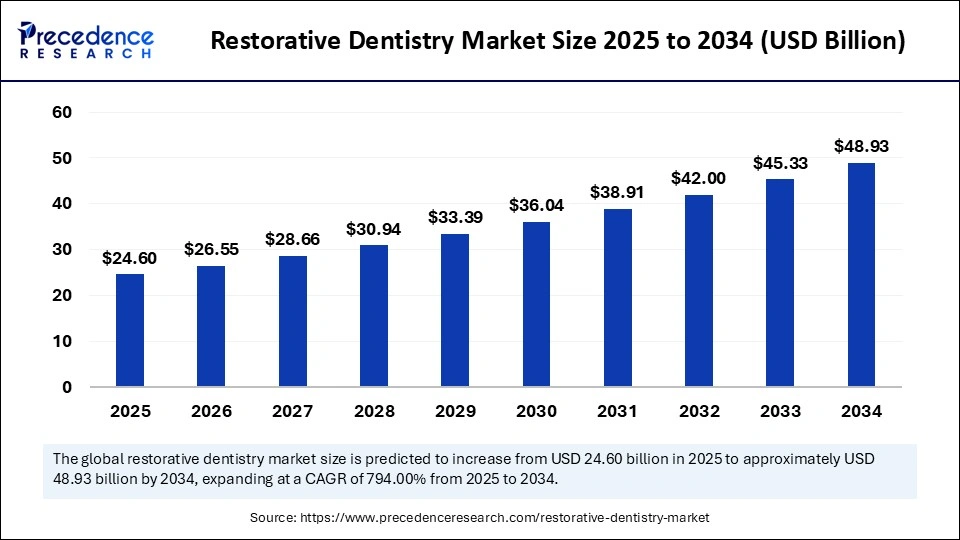
Market Overview
The restorative dentistry market comprises a wide range of materials, instruments, and technologies used to repair, replace, and restore damaged or missing teeth. It encompasses restorative materials, prosthetics, Dental implants, and related equipment utilized across conservative dentistry, endodontics, implantology, and prosthodontics. The market’s growth is fueled by the rising prevalence of dental disorders, an aging global population, growing dental tourism, and rapid advancements in CAD/CAM and 3D printing technologies. Key end-users include dental clinics, hospitals, laboratories, and academic institutions worldwide, all contributing to the continuous expansion and innovation within the field.
Market expansion is further supported by the growing emphasis on oral health awareness, aesthetic dentistry, and minimally invasive techniques that enhance both function and appearance. Patients increasingly prefer durable, natural-looking restorations, prompting clinicians to adopt advanced composites, ceramics, and adhesive systems over traditional metallic options. The integration of digital workflows, such as intraoral scanning, chairside CAD/CAM fabrication, and rapid milling, has streamlined treatment processes and improved precision while reducing reliance on external dental labs. Additionally, the shift toward preventive and early-intervention dental care, along with favorable reimbursement structures and rising dental insurance coverage, is creating new opportunities for premium restorative solutions. Overall, restorative dentistry stands at the intersection of material science, digital innovation, and patient-driven aesthetics, shaping the future of modern dental care.
Key Technological Shifts in the Restorative Dentistry Market
The restorative dentistry market is undergoing a major technological transformation driven by the integration of digital workflows and biomimetic materials, enabling faster, more predictable, and highly aesthetic outcomes that closely replicate natural teeth. Intraoral scanning combined with AI-assisted design ensures restorations with exceptional marginal fit and precision, while advanced materials such as high-strength zirconia and hybrid ceramics deliver superior durability and lifelike translucency.
Chairside CAD/CAM systems have revolutionized restorative procedures by enabling single-visit dentistry, significantly reducing patient turnaround times and minimizing dependence on dental laboratories. Meanwhile, additive manufacturing and precision milling techniques allow for customized surface textures and enamel-like translucency, enhancing both function and appearance. The emergence of bioactive sealants and ion-releasing composites is further improving restoration longevity by supporting remineralization and preventing secondary caries. Collectively, these innovations—blending digital precision with smart, biofunctional materials—are redefining clinical standards, elevating patient satisfaction, and reshaping the economic dynamics of modern dental practice.
Market Key Trends
- Shift Toward Single-Visit Restorations: Growing adoption of CAD/CAM and in-office milling technologies is enabling single-visit, chairside restorations, reducing turnaround time and enhancing patient convenience.
- Rise of Advanced Aesthetic Materials: The market is witnessing a surge in the use of high-strength ceramics and adhesive composite systems that deliver superior durability, translucency, and natural esthetics compared to traditional materials.
- Integration of AI in Dental Workflows: AI-powered tools are increasingly being utilized for margin detection, shade matching, and quality assurance, improving accuracy, consistency, and overall treatment outcomes.
- Laboratory Consolidation and Digital Integration: Dental labs are undergoing consolidation and vertical integration, forming digital design-to-manufacture pipelines that streamline workflows and enhance production efficiency.
- Growing Demand for Turnkey Service Models: Clinicians are seeking comprehensive service solutions that combine restorative materials, digital systems, training, and maintenance support, reflecting a broader shift toward integrated, end-to-end practice solutions.
Market Drivers
Aesthetics Meets Durability: Patient Preferences Reframe Practice
Patients are increasingly demanding restorative dental solutions that combine natural aesthetics with long-term durability, driving the adoption of advanced materials and digital precision technologies. This growing preference for lifelike, functional restorations encourages clinicians to invest in CAD/CAM systems, intraoral scanners, and AI-driven design tools that enable efficient, high-quality, and same-day treatments. The willingness of patients to pay for premium restorative procedures supports higher-margin clinical services, incentivizing continuous digital transformation within practices. Moreover, manufacturers offering validated clinical workflows and training programs are seeing accelerated adoption, as practitioners seek reliable solutions that minimize procedural risks. Ultimately, the pursuit of natural-looking, lasting smiles has become a key catalyst for innovation and growth across the restorative dentistry market.
Market Restraint
Cost and Competency: Barriers to Universal Adoption
Despite technological progress, high upfront costs for advanced equipment such as chairside milling units, 3D scanners, and automated lab systems pose a major barrier, particularly for small and mid-sized practices. Effective use of these systems also requires extensive clinician training and collaboration with dental laboratories, which demands both time and financial investment. In many regions, limited reimbursement coverage for aesthetic and restorative procedures means patients must bear out-of-pocket expenses, restricting accessibility among cost-sensitive populations. Additionally, supply-chain challenges related to high-purity ceramics and precision tools can hinder workflow consistency. These financial and skill-related hurdles collectively slow the widespread adoption of digital restorative technologies.
Market Opportunity
Democratizing Precision Restorations
Significant opportunities exist in making advanced restorative solutions more accessible and affordable. Emerging modular business models—including financing options for chairside systems, cloud-based CAD platforms, and pay-per-use milling services—are reducing capital barriers for smaller dental practices. Collaborative frameworks between clinics and centralized digital labs can further expand access to precision restorations while maintaining high quality standards. The development of cost-effective, bioactive, and durable restorative materials will also unlock demand in emerging markets, where aesthetic dentistry is on the rise. Moreover, opportunities are expanding through tele-dentistry and remote design consultation pathways, enabling cross-border collaboration and efficient service delivery. By democratizing digital precision, the industry can capture vast untapped potential and extend restorative excellence to a broader patient base worldwide.
Regional Insights
The North American restorative dentistry market holds a leading position globally, driven by high dental care expenditure, strong adoption of digital dentistry technologies, and a large base of well-established dental practices and laboratories. The U.S. remains the primary revenue contributor, supported by the growing popularity of cosmetic and implant dentistry, favorable insurance coverage, and the rapid uptake of chairside CAD/CAM systems. Increasing awareness of oral health and aesthetic appeal continues to strengthen patient demand for advanced restorative procedures, while the presence of major dental manufacturers such as Dentsply Sirona, Align Technology, and 3M further propels regional innovation.
In Europe, the market benefits from robust dental infrastructure, comprehensive reimbursement frameworks, and a strong tradition of clinical excellence in restorative care. Countries such as Germany, Switzerland, France, and the U.K. are at the forefront of adopting biomimetic materials and AI-integrated dental workflows. The rising emphasis on minimally invasive dentistry and sustainability in dental materials is also shaping purchasing preferences. Increasing collaborations between dental universities, manufacturers, and laboratories are further enhancing clinical outcomes and expanding the reach of digital restorative technologies across the continent.
The Asia-Pacific region is emerging as the fastest-growing market for restorative dentistry, fueled by rising disposable income, growing dental tourism, and expanding awareness of oral aesthetics. Countries such as China, Japan, India, and South Korea are witnessing a surge in demand for cosmetic and restorative dental procedures, supported by rapid urbanization and improved healthcare access. Additionally, government initiatives promoting oral health and the expansion of dental education and training programs are creating a conducive environment for market growth. Local manufacturers are increasingly investing in affordable CAD/CAM systems and composite materials, positioning Asia-Pacific as a major hub for cost-effective, high-quality dental care solutions.
- In October 2025, A prominent Glasgow clinician praised Scotland’s move to introduce regulations for non-surgical cosmetic procedures, while cautioning that the proposed legislation must go further to ensure comprehensive patient protection. Dr. Andrew Culbard, Clinical Director of Aesthetic & Restorative Dentistry, Orthodontics, and Facial Aesthetics at the Scottish Dental Care Group, described the new proposals as a crucial advancement for public safety. In his remarks to The Herald, Dr. Culbard emphasized that Scotland’s decision to regulate non-surgical cosmetic treatments is not merely a legislative milestone; it represents an essential step toward safeguarding the public from potential harm.
- In October 2025, Dentistry today transcends the traditional realm of filling cavities and repairing damaged teeth; it has evolved into a refined confluence of medical science, engineering precision, and digital innovation, capable of profoundly transforming lives. At the forefront of this revolution stands Dr. Jasdeep Kaur Cheema, an accomplished implant restorative dentist whose inspiring journey from Punjab to global acclaim mirrors both her unwavering determination and the remarkable evolution of modern dentistry itself.
Segments Covered in the Report
By Product Type
- Restorative Materials (Direct & Indirect)
- Implants
- Prosthetic Materials
- Restorative Equipment
By material type
- Metal / Metal Alloys
- Ceramics / All-Ceramic
- Composite Resins
- Biomaterials
- Bonding Agents / Adhesives
- Impression Materials
By Application / Treatment Type
- Conservative & Endodontics
- Implantology
- Prosthodontics
- Other Restorative Treatments
By End-User
- Dental Hospitals & Clinics
- Dental Laboratories
By Region
- North America
- Europe
- Asia-Pacific
- Latin America
- Middle East and Africa
Get sample Link: https://www.precedenceresearch.com/sample/7016

 by
by