
 by
by Driven by AI Adoption and Rising Demand for Early, Less Traumatic Diagnostics, Market Set for Robust Growth Through 2034
The global minimally invasive medical imaging market is poised for substantial growth, propelled by a CAGR that reflects increased patient preference for less invasive procedures and the integration of advanced technologies such as AI.
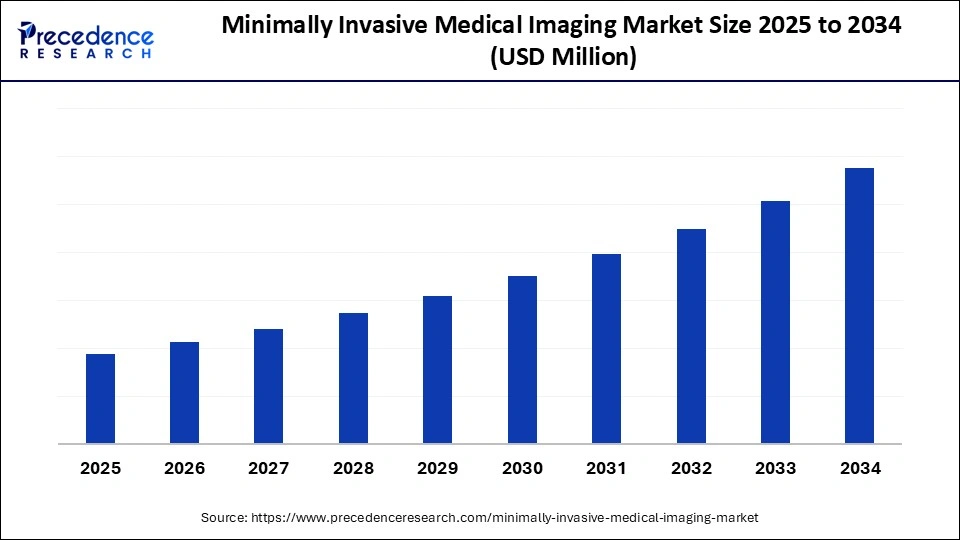
Key growth drivers include rising chronic disease prevalence worldwide, continuous innovations in imaging modalities like ultrasound, CT, MRI, and fluoroscopy, and growing demand for early diagnostics with minimal trauma. These factors are collectively accelerating the adoption of minimally invasive medical imaging systems that enable precision diagnostics and treatments while reducing hospital stay and improving patient outcomes.
Minimally Invasive Medical Imaging Market Key Insights
-
The market is dominated by North America, benefiting from established hospital networks and regulatory facilitation.
-
Asia Pacific is identified as the fastest-growing region, driven by rapid hospital expansion and public health initiatives.
-
X-ray imaging held the largest modality share at 25% in 2024, favored for cost-effectiveness and accessibility.
-
Oncology applications lead with 35% market share due to cancer prevalence and targeted therapy needs.
-
Hospitals command a 55% share as the primary end users, while ambulatory care centers show rapid growth.
-
AI integration is reshaping the landscape by enabling real-time imaging enhancements and surgical precision improvements.
AI Role in Minimally Invasive Medical Imaging Market
Artificial Intelligence is revolutionizing minimally invasive medical imaging by enhancing the accuracy, speed, and safety of procedures. AI-enabled algorithms perform real-time image enhancement and 3D reconstructions, improving clinician visualization and diagnostic precision.
These advances facilitate better neurosensory observation and predictive analytics that support complex surgical decisions. For instance, Intuitive’s Ion system integrates AI for lung biopsies, streamlining procedures and reducing patient risk. Together, these innovations underpin a trend toward smarter, image-guided care that merges precision with improved patient recovery times.
Minimally Invasive Medical Imaging Market Growth Factors
The market’s growth is markedly driven by rising chronic diseases coupled with patient and clinician preference for less traumatic interventions. Technological breakthroughs in imaging systems and rapid AI adoption are central accelerants. Increasing healthcare investments and expanding hospital infrastructure in key regions further stimulate demand. The development of portable and point-of-care devices additionally broadens accessibility, heightening early diagnostic capabilities.
Minimally Invasive Medical Imaging Market Scope
| Report Coverage | Details |
| Dominating Region | North America |
| Fastest Growing Region | Asia Pacific |
| Base Year | 2025 |
| Forecast Period | 2025 to 2034 |
| Segments Covered | Modality, Application, End User and Region |
| Regions Covered | North America, Europe, Asia-Pacific, Latin America, and Middle East & Africa |
Minimally Invasive Medical Imaging Market Opportunities and Trends: What New Developments Are Shaping the Market?
Recent breakthroughs in immunomodulatory encapsulation technology suggest new avenues for integrating advanced imaging with cell and gene therapies. For example, ultrapure alginate bead encapsulation systems for Parkinson’s disease cell therapy minimize immune response, potentially reducing the need for immunosuppression. Dual-porous immunoprotective membranes further enable better nutrient flow and cell protection, promising enhanced treatment effectiveness.
How Is AI Further Advancing Imaging Precision?
AI is increasingly matched with real-time intraoperative imaging, guiding surgeons with enhanced navigation and decision-making tools. The convergence of imaging and surgical navigation minimizes complications and supports faster procedure times, enabling complex interventions through smaller incisions.
Minimally Invasive Medical Imaging Market Regional and Segment Analysis
North America continues to lead market adoption, driven by large hospital networks, regulatory approvals, and innovation in AI-enabled radiology devices. The U.S. electronic and regulatory environment facilitates rapid commercialization of next-gen imaging systems, enhancing operational efficiencies.
Asia Pacific is expanding swiftly with growing hospital infrastructure and governmental health initiatives. India exemplifies this trend with investments in 4K NIR laparoscopic imaging and robotic cardiac suites, highlighting rising clinical uptake beyond metropolitan areas.
Segment-wise, X-ray imaging remains the most utilized modality due to cost and accessibility, while MRI is the fastest growing modality, favored for soft tissue imaging and zero radiation exposure.
Oncology is the leading application, fueled by the need for early cancer detection and precision therapies. Cardiovascular imaging is quickly gaining prominence due to rising cardiac diseases and improved intervention technologies.
Hospitals dominate as key end users due to procedural complexity and infrastructure, while ambulatory centers gain market share for outpatient services..
Challenges and Cost Pressures
The market faces challenges such as technical limitations in minimally invasive imaging, including field of view constraints, haptic feedback, and visualization issues, especially in complex surgical settings. These factors contribute to increased procedure time and fatigue, impacting uptake. Cost pressures arise from expensive imaging equipment and high operational expenditure, limiting adoption in lower-resource settings.
Case Study: India’s Rising Clinical Adoption
In 2024, India witnessed rapid leapfrogging in clinical services with the introduction of high-resolution laparoscopic systems and robotic cardiac suites, enabling same-day procedures and expanding cancer screening efforts. This shift is supported by strong public-private hospital investments and policy focus on early detection, significantly increasing minimally invasive diagnostic procedures.
Top Key Players In Minimally Invasive Medical Imaging and Their Offering
- GE HealthCare– Provide and enhance minimally invasive procedures and surgeries, primarily through its Image Guided Systems (IGS) and Surgical Imaging (C-arm) platforms.
- Siemens Healthineers- Siemens Healthineers provides a comprehensive portfolio of minimally invasive medical imaging solutions, primarily through its Image Guided Therapy (IGT) systems.
- Philips Healthcare– Philips Azurion is a next-generation image-guided therapy platform used in cath labs, interventional radiology (IR) labs, and Hybrid ORs.
- Canon Medical Systems- Canon Medical Systems leverages high-resolution imaging technology, including its Alphenix interventional X-ray systems and non-contrast MRI techniques, to support minimally invasive procedures.
- Fujifilm Holdings Corporation- ELUXEO® Surgical System provides high-definition (HD) and 4K UHD imaging, featuring advanced visualization modes like Linked Color Imaging (LCI®) and Blue Light Imaging (BLI) to enhance observation and detection during procedures.
- Medtronic- O-arm™ Surgical Imaging System is an intraoperative 2D/3D imaging system that provides high-definition, 360° rotational imaging capability.
- Intuitive Surgical- Intuitive Surgical integrates advanced minimally invasive medical imaging technologies directly into its robotic surgical systems, to enhance a surgeon’s visualization and control during procedures.
- Boston Scientific- SpyGlass™ DS system for visualizing and biopsying biliary ducts, and interventional radiology tools such as the EMBOLD™ Detachable Coil System.
- Stryker Corporation- 1788 Platform, Stryker’s latest generation surgical camera system for minimally invasive surgery. It provides 4K resolution images, a wider color gamut, high dynamic range (HDR).
- Olympus Corporation- Systems like the EVIS X1 and VISERA ELITE III offer advanced imaging capabilities, including 4K and 3D visualization, which provide superior clarity an depth perception for surgeons.
Other Major Players
- Hologic, Inc.
- Esaote S.p.A.
- Hitachi Medical Corporation
- Johnson & Johnson (Ethicon)
- Samsung Medison
- Mindray Medical International
- Carestream Health
- Konica Minolta Healthcare
- Neusoft Medical Systems
Segments Covered in the Report
By Encapsulation Method
- Microencapsulation
- Nanoencapsulation
- Macroencapsulation
By Polymer Type
- Natural Polymers (e.g., alginate, chitosan)
- Synthetic Polymers (e.g., polyethylene glycol, polyacrylates)
By Application
- Drug Delivery
- Regenerative Medicine
- Cell Transplantation
- Research & Development
- Probiotics
By Technology
- Extrusion
- Electrostatic Dripping
- Rotating Disk Atomization
- Layer-by-Layer Coating
- Others
By End-User
- Pharmaceutical & Biotechnology Companies
- Contract Development and Manufacturing Organizations (CDMOs)
- Academic & Research Institutes
- Others
Read Also: Neoantigen Cancer Vaccine Market
You can place an order or ask any questions. Please feel free to contact us at sales@precedenceresearch.com |+1 804 441 9344

- Battery Swapping Market Size to Achieve USD 24.74 Billion by 2035 - March 5, 2026
- Dental Air Polishing System Market Size to Grow to USD 1603.54 Million by 2035 - March 4, 2026
- Aviation Insurance Market Size to Touch USD 9.66 Billion by 2035 - February 26, 2026
